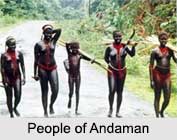
 People of Andaman include the Andamanese, the Onges, the Jarawas and the Sentinelese, who are the native inhabitants of Andaman and Nicobar Islands. Despite their spiritual differences, linguistic variations and the protective affiliations, these people have been fused in a very interesting community of people. There are Hindus, Muslims, Christians, and Sikhs in the islands. However, influences of Christianity have affected indigenous traditions, worship systems and belief. The Andamanese are categorized as Scheduled Tribe.
Types of People of Andaman
The original tribal people who lived here are the great Andamanese, Jarawas, Sentinelese and Onges in the Andaman group, and the Nicobarese and Shompens in the Nicobar group. Following are the different people of Andaman:
Malabari Muslims: The Moplahs or the Malabari Muslims comprise a fairly large group that settled down in the Andaman in the twenties of the present century. These people were banished as rebels from the Malabar area. However, they keep on preserving their original languages, customs, traditions, dress and other cultural attributes, yet they have become one with other inhabitants of the Andaman through Hindustani and other communal dealings; social, economic and cultural.
East Bengal Refugees: The East Bengal refugees are yet another major ethnic group of the islands. These people started settling in the rural areas of the South, Middle and North Andaman in 1949. They have built self-sufficient villages. The Christian community of the Karens migrated in mid-twenties of the current century to work in forest department of the Andaman. The laborers on contract basis are mainly brought from the Chota Nagpur plateau of Bihar and they mostly come from the tribal communities of Kharia, Munda and Uraon.
Andamanese: It is believed that the indigenous Andamanese came from the Negro accumulation. They are said to have reached these islands as a result of a shipwreck while being transported as slaves from Africa by the Portuguese. On the whole, the aboriginal Andamanese are a wandering tribe who has been moving from place to place in search of food throughout the centuries.
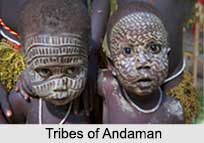 On the basis of the habitat, the people of Andaman fall in two broad categories. The "Eremtaga" category includes those people who live in the interior and derive their food from the forests, mostly meat and roots. The "Ariotos" are coast dwellers and they obtain their food from sea. Thus they are expert swimmers, divers and fishermen. Since their mode of fishing is shooting (with bow and arrow), these hardier people are also first rate marksmen in the field of harpooning. On the basis of their tongues and different bows as well as baskets, the Andamanese fall in many categories. As per widely prevalent myth, and highly venerated by these people, they once inhabited a continuous landmass. A great cataclysm leading to the submergence of many land portions is held responsible for dividing them. According to them, that is why they speak different dialects and the various tribes do not any longer even understand one another`s tongue.
Major Tribes of Andaman
In the Great Andaman, 10 major tribes have been living. Out of these four (Aka Bo, Aka Cari, Aka Jeru and Aka Kore) are found in the northern group while the rest (Aka Bale, Aka Bea, Aka Juwai, Aka Kede, Aka Kol and Aka Pucikwar) fall in the southern group. In the Little Andaman Group the Onges (Little Andaman Island) the Jarawas (South Andaman Island) and the Sentinelese (North Sentinel Island) are the major tribal people. On the other hand although the Jarawas and the Sentinelese show some cultural similarities, they are treated as separate groups mainly on the basis of their habitat and reaction towards the outsiders. Resultantly although there are no census records of these tribal groups, it is estimated that there may not be more than five hundred of these people in the Andaman Islands. Their death rate has risen quite high and their breeding rate has fallen miserably low.
Twelve Tribes of Andaman
The Andamanese, prior to the period of their decimation, were divided into twelve tribes or sets. Each tribe had its own language, its special: territory and hunting grounds, which it guarded against all neighboring tribes. The twelve tribes from the North to the South are as follows:
•Charior
•Kede
•Bea
•Kora
•Jewai
•Balawa
•Tabo
•Kol
•Onge
•Yere
•Bojigyal
•Jarawa
Though the Andamanese are divided into twelve tribes, yet if their standard of living, the bows and arrows they use for hunting, the canoes, ornaments, clothing, utensils, etc. are taken as the criteria, they can be divided into only 3 distinct groups, each having distinct characteristics of their own. Previous to the tribal warfare each tribe had its own territory or hunting ground which it guarded with a dragon`s jealousy Trespassing upon another`s ground for food or hunting was considered a serious offence and led to bitter hostility. Incursions of this sort were not uncommon among the tribes.
Andamanese Language
The number of speakers of the Andamanese language has been steadily decreasing. Anadamanese dialects are usually classified into northern, central and southern groups. Of these the southern Andamanese language is the most archaic. The dialect of little Andaman Island is the use of affixes to specify the functions of the words of a sentence. The language has no number system.