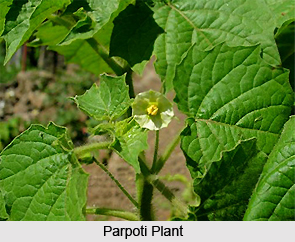
 Parpoti is an herbaceous annual plant which grows to a height of thirty centimeters and it is found almost everywhere in India. The Botanical name of this plant is Physalis minima. There are various other names by which Parpoti is known in different languages in India and these are Bantepariya and Bontaperi in Bengali, Bandapariya, Tulatipati and Chirpoti in Hindi, Njodi Njotta in Malayalam, Habbikaknaj in Punjabi, Tholtakkali in Tamil, Gudde Hannu and Guppatte Gida in Kannada, Chirboti and Dhanmori in Marathi, Laksh-Mipriya and Tankari in Sanskrit and Buddabudama and Kupanti in Telugu. Parpoti is distributed almost in all parts of India as a common weed in cultivated fields and other open, disturbed sites at an elevation of about 2000 meters in the Himalayas.
Parpoti is an annual and herbaceous plant which is up to 30 centimetres in height and possesses striate stems which are often pubescent. The leaves of this plant are alternate, ovate-sinuate, and are 2.5 to 6.3 centimetres long and 1.3 to 3.8 centimetres wide, more or less pubescent, apex acute, base cuneate, margins shallowly toothed or lobed. The petioles are 1.3 to 3.2 centimeters long. Flowers of Parpoti are solitary and the pedicels are very slender, nodding, about 3 to 8 millimeters long. Corolla is yellow in colour with purple spots at the base. The fruit (berry) of this plant is round, about 8 to 12 millimeters in diameter, green, many-seeded, entirely enclosed in the enlarged, 5 to 10-ribbed membranous calyx. Seeds of this plant are smooth or tuberculate, rugose, compressed, about 2 millimeters in diameter, and orange-yellow in colour. Fruits and flowers are seen in Parpoti almost throughout the year.
The fruits of Parpoti are considered to be tonic, purgative and diuretic. They are used in the treatment of gonorrhea, gout, dropsy and certain urinary diseases, and as an ingredient in medicinal oil used for treating in case of the enlargement of the spleen. The leaf-juice, mixed with water and mustard oil, is used as a remedy for earache. In Ayurveda, the root of this medicinal plant of India is used for treating blood disorders, fever and bronchial asthma. In Siddha, the whole plant is used in the treatment of dysuria, diabetes and to provide relief from swellings.