 Pagri, the traditional Indian turban, comprises of a single piece of cloth, resembling a scarf. The cloth-piece is coiled round the head to form the respectful headgear, the Pagri.
Pagri, has inherent connection with the culture of the Indian civilization. The core scriptures of Hinduism, and at large, the Indian civilization, the Vedas, speak about the turban, as an essential constituent of the costume of Indian men.
Pagri, the traditional Indian turban, comprises of a single piece of cloth, resembling a scarf. The cloth-piece is coiled round the head to form the respectful headgear, the Pagri.
Pagri, has inherent connection with the culture of the Indian civilization. The core scriptures of Hinduism, and at large, the Indian civilization, the Vedas, speak about the turban, as an essential constituent of the costume of Indian men.
The diversity in the outlook of the Indian turban is mind-blowing. It can be made of cotton muslin, tie-dyed i.e., bandhani fabric, zigzag pattern, called lahariya, stone-studded Pagri, worn by the kings, and so on. Even the colors of Pagri, has different connotations.
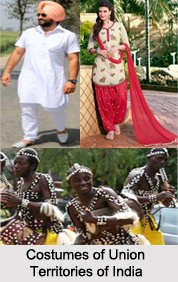
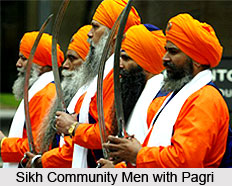
For example, the Sikh Khalsa community, exhibit themselves in orange or navy Pagri, because these are their traditional hues. It is meant for attending religious observance or commemoration programmes. Again pink or red happen to be the colour of revelry and festivity, of joy and harmony Thus it is suitable for wedding party, and other social ceremonies.
 Pagri has a religious significance in the Sikh Khalsa community. The Khalsa men, go through a baptism ceremony, which forbids them to cut their hair throughout their life. To organize their long hair into a managable fold, the Khalsa Sikhs , find it necessary to enclose the long flowing hair into the case of the turban or the Pagri. The Pagri cloth is winded afresh every time, the Khalsa Sikh, install the Pagri. The Sikh name of the Pagri, is Dastar.
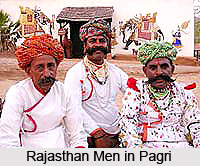
The elegant Pagri is a venerated part of the traditional costume in Rajasthan. The men hailing from the Rajput community adorn themselves in Pagri, endowed with a regal aura. The Hindi vernacular term for Pagri is safa.
In Rajasthan, the caste, class and the place of origin, are well signified by the pattern of the Pagri. For example, the people of Udaipur don themselves in a flat Pagri, while the Safa , is bestowed with slightly curved bands. Furthermore, the fabric of the Pagri also conveys the class of the wearer. A person, flaunting himself in a silk Pagri, is definitely from the upper strata of the society.
The material of the Pagri cloth, the outer decorations, and the design, is adapted, keeping in mind the purpose it is assigned for.
Pagri, with its air of perennial sophistication and aristocracy, has become a treasured custom of costume-heritage in India .