Nimbark Sampraday
Nimbark Sampraday was synonymous with Parasuramdevji. The literary items of Nimbark Sampraday concentrated on the exaltation of God.

Share this Article:

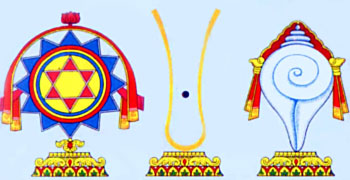
ShankhchakraNimbark Sampraday is one of the four well known Sagun bhakti sampradayas, with its main seat at Salemabad in Rajasthan. The Sampraday was established by Parsuramdevji, the disciple of Harivyasdevacarya. He is said to be a Gurjar Gaud Brahmin of village Thikariya. Some poems of Parasuramdevji are Samjhani, Hindolo, Vipramtisi, padas and sakhis. Parasuramdevji had flourished from 1520 to 1600.

The poetry of Parasuramdevji consists of 2225 sakhis (dohas), 15 Carit and 13 Lila poems respectively in kavitt, savaiya and doha-caupai metres and about 600 padas. The sakhis are on 250 miscellaneous topics called Jodau, such as Pardesi Pritam ko, Virah Agani ko, Virhani ko, Hari Bhagati Hin ko.

Being the Acarya of the Nimbark Sampraday, Parsuramdevji was a devotee of the Sagun bhakti. The Carit and Lila poems are narrative and describe various incidents relating to the famous bhaktas, lilas of Incarnations, and exaltation of God. The Carit poems such as Das Avatar, Raghunath, Srikrishna, and Prahlad and Lila poems such as Amar Bodh, Nam Nidhi, Sanc Nisedh, Nij Rup, Nirwan and Hari Lila are his major narrative poems. Besides his sakhis, many padas dealing with the Nirgun bhakti are equally important. The main note of the sakhis is virah and love of God. The sakhis and the padas record his mystic experiences. The padas, besides other topics, also deal with the Sagun and Nirgun bhakti. Straight-forward self-communication and the spirit of surrender are notable in his stray verses. In his poems the heroic and redeemer aspects of Lord Rama and Lord Krishna are prominent, which is the main tendency of the Rajasthani Historical and Heroic poetry.

All the aspects of Navadha and five types of Bhakti, including the Nirgun type of Kanta bhakti and mysticism are depicted in the padas of Parsuramdevji. The Nikunj bhakti and upasana of Sahcari-Bhav are the accepted forms of upasana in this Sampraday. This is deemed to be a strict secret. It is important that Parasuramdevji has kept this sort of upasana as quite personal; it has not been indicated in his poems. Some of his expressions are so profound that they have become popular sayings in Rajasthan. His language is simple Rajasthani with a sprinkling of Braj here and there. His poetry is an example of synthesis, harmony and co-existence in the cultural and religious fields. His padas and Lila poems are meant to be sung in various musical modes. The Lila poems are a sort of Akhyan Kavya.

Tatwavetta is said to be the disciple of Parsuramdevji. His main seat was at Jaitaran. There he founded the Gopal Dwara, where a collection of his poems called Tatvettaji ki Vani is said to have been preserved in the manuscript form. The chappayas are in praise of God, the Incarnations and of famous mythological figures such as Narad, Janak, etc. The Vani mainly deals with perception and precepts. The language is Rajasthani mixed with Braj.

Thus it can be concluded saying that Nimbark Sampraday was mostly concerned with mythological figures and their exaltation.
Share this Article:

Related Articles

More Articles in Indian Literature


Mythological Themes in Indian Literature
Mythological themes in Indian literature have been integral to every ancient and contemporary writer and their path to f
Literature under Delhi Sultanate
Literature during the period of Delhi Sultanate was produced not only in Persian and Sanskrit but also in other regional languages.
Epics in Tamil Literature
Epics in Tamil Literature refer to the Five Great Epics namely Cilappatikaram, Manimekalai, Valayapathi, Civaka Cintamani and Kundalakesi. There are also the Five Lesser Epics in Tamil Literature.
Literature During Gupta Age
It is during the Gupta Age literature in the form of poetry, epos and drama gained a colossal importance.
Post-Sangam Age in Tamil literature
Post-Sangam age in Tamil literature basically saw the tremendous rise of Hindu saintly literary treatises in two sects.
Epics in Sanskrit Literature
Epics in Sanskrit Literature are the store house of historical knowledge and the providers of knowledge about Indian philosophies and thought.
Literature of Aravidu Dynasty
Sanskrit and Telugu were the popular literary medium of communication during Aravidu dynasty.
Indian Literature in archaic Indian Language
Indian Literature, accredited as one of the antique literature of the world is the confluence of different beiefs .
Renaissance in Bengali Literature
Renaissance in Bengali literature was the first structured gestation of the modern trends in Bengali literature.
Renaissance in Indian Literature
Renaissance in Indian Literature has brought and culminated towards several significant changes in the overall writing styles and patterns. With the renaissance in Indian literature, readership has enlarged with a literary and education explosion.
Renaissance in Hindi Literature
The renaissance in Hindi literature crafted a whole fresh diction to the Hindi literary works with its poise and rhythm.
Indian Literature in Modern Age
Indian Literature in Modern Age is the literary insurgency that is marked by several idealistic revolutions and the effect of globalization, and socio-economic as well as cultural changes.
Playwrights in Tamil Literature
Playwrights in Tamil Literature such as Cankaratas Cuvamikal, Ilatcumana Pillai and Pammal Campanta Mudaliar have written several works for the development Tamil plays and drama.
Rabindranath Tagore
Rabindranath Tagore, a renowned poet, was honoured the Nobel Prize for Literature for the famous ‘Gitanjali’ and wrote the national anthem.
Munshi Premchand
Munshi Premchand was a legendary Indian writer notable for his modern Hindustani literature. A writer of a very high caliber, Premchand`s writings have a very long lasting impression on the reader’s minds.
Sanskrit Poets
The names of some of the Sanskrit Poets are Bharavi, Devarshi Ramanath Shastri, Jayadeva and Srinivas Rath.
Ashapurna Devi
Ashapurna Devi was a Bengali novelist who through her works portrayed the struggles of the lives of the women in the 20th century.
Bengali Literature
The Bengali script has been derived from the Brahmi alphabet of the Ashokan inscriptions. Bengali or Bangla, is essentially a member of the Indo-European family of languages.
History of Tamil Literature
History of Tamil Literature has a rich literary tradition spanning more than 2000 years. It encompasses ancient Sangam literature, which includes classic works like Silappatikaram and Manimekalai, and later periods marked by religious and philosophical texts. Tamil literature has evolved through various genres, reflecting the cultural, social, and linguistic heritage of the Tamil people.
Indian English Literature
Indian English Literature includes the works of Indian writers writing in English. Indian English Literature developed during a time when the country was looking forward in creating its own identity in English writing.