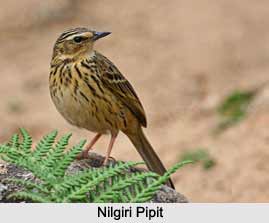
 Nilgiri Pipit is an Indian bird that bears a scientific name "Anthus nilghiriensis" and has the brown colour throughout the body.
Description of Nilgiri Pipit
Nilgiri Pipit was first described by Jerdon in 1840 under the name of Anthus rufescens, a name already used by Temminck for a different species. Blyth referred to it under the name of Anthus montanus. These are however invalid names and it was re-described under replacement name of A. nilghiriensis by Richard Bowdler Sharpe in 1885.
Category of Nilgiri Pipit
Nilgiris Pipit is a distinctive species of pipit that is endemic to the high altitude hills of southern India.
Uniqueness of Nilgiri Pipit
Nilgiri Pipit is richer brown in colour than other pipits in the region. It is non-migratory and has a tendency to fly into low trees when disturbed.
Size of Nilgiri Pipit
Nilgiri Pipit is about 12.6-14 centimetres long and is richly coloured, has dark lores, a buff supercilium and throat. It lacks any malar stripes. The flanks, breast and sides of neck are brighter buff and that bill is completely dark. The crown is heavily streaked in black as are the upperparts. The outer tail feathers are also buff coloured and there is no white in the plumage. The streaking on the breast is fine and it extends along the flanks.
Structure of Nilgiri Pipit
The first four primaries of the wing of Nilgiri pipit are almost equal and the fifth is about 1-2 mm shorter. The primaries from the second to the fifth are emarginated. The tail feathers are pointed and the second outer feather has a tapering triangle along the shaft and the third with a small triangle at the tip.
 Habitat of Nilgiri Pipit
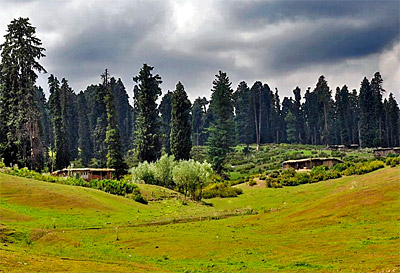
Nilgiri Pipit is closely associated with short montane grasslands interspersed with marshy grounds and small streams mostly in hill slopes above 1,000 metres (3,300 ft) in the Ponmudi hills and above 1,500 metres (4,900 ft) in the Nilgiris Mountain Range, Palni Hills, Tamil Nadu and High Ranges.
Behaviour of Nilgiri Pipit
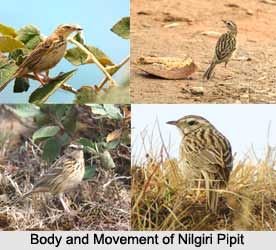
Nilgiri Pipits are found singly or in pairs. When disturbed they usually fly into a low bush or tree.
Breeding of Nilgiri Pipit
Nilgiri Pipits breed in summer from April to July.
Nests of Nilgiri Pipit
The nest of Nilgiri Pipits is a cup of grass made of short grass.
Clutch of Nilgiri Pipit
The clutch of Nilgiri Pipits consists of two to three grey brown speckled eggs.
Feeding of Nilgiri Pipits
Nilgiri Pipits feed on grass seeds and insects with invertebrates becoming more important during the breeding season.