 Agni Purana states that the Navami Vratas are performed on days of the ninth phase of the moon`s wane or increase and it grant enjoyment of creature-comforts in this life and salvation in the next. The Vrata, known as the Gouri Navami, should be practised on the day of the ninth phase of the moon`s increase in the month of Ashvina, wherein the Devi should be worshipped with utmost dedication. The Vrata known as the Pishtashi Navami should be practiced on the same day as the above, marked by the presence of the sun in the asterism Mula at the sign of the Virgo. The practitioner of the Vrata eats nothing else than cakes that day.
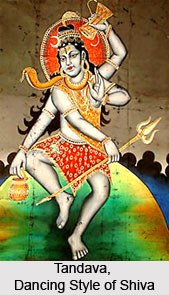
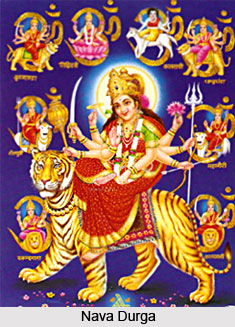
It has been stated in the Purana that of all the Navami Vratas, the greatest is that which is known as the Aghardana Navami. The goddess Nava Durga should be worshipped as possessed of eight, ten or sixteen hands, as well as the images of Anjana and Damaru. Similarly the different manifestations of the goddess, such as Rudrachanda, Prachanda, Chandogra, Chandanayika, Chanda, and Chandavati should be successively worshipped, the goddesses such as Ugrachanda, Goddess Durga, and Mahishamardini, having been worshipped in course thereof. The Mantra, with which the worship should be conducted, runs as "Om obeisance to Durga and Durga, who is the protectress of the universe". The rite of Anganyasa should be performed in the different parts of the body, commencing from the tips of fingers. The man who performs this rite of mysterious Nyasa, overcomes all impediments in life, and cannot be bound down by any person. The goddess should be worshipped, as carrying in her left hands a skull, a Khetaka, a bell, a mirror, a bow, a banner, a small drum, and a Pasha, while a finger of one of her left hands should be contemplated as held in a pointing attitude. The arms and weapons of the goddess, such as a spear, a club, a trident, a thunder-bolt, a sword, a Kuntakam, a conch-shell, a discus, and a rod should be worshipped as well.
The Purana narrates that an animal should be killed in the performance of the Vrata. And then jets of blood, gushing out of the decapitated animal, as well as its flesh, should be dedicated to Putana at the south-west, to the monstress of sin at the north-west, to the demoness Charaki at the north-east, and to Vidarika at the south-east, the flesh known as the Mahamansha is dedicated to the fire-god. The king should bathe in front of the, image of the goddess, and cut in two the image of his enemy, made of rice-paste. Offerings should be made to Skandha and Vishaka, and the goddesses such as Brahmi etc. should be worshipped in the dead of night, by repeating the Mantra. The image of the goddess should be bathed in the composition known as the Panchamrita, and worshipped with oblations and offerings. The man, who carries the image of the goddess in a car offers animal sacrifice, or plants a banner on the top of her temple, enjoys all bliss.