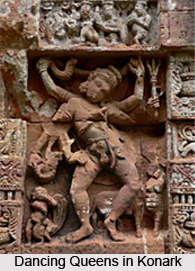
 Lord Shiva has been held in a high esteem as the king among dancers that is Nataraja. The cosmic dancer dances in all its three aspects of creation, preservation and destruction. The images of dancing Shiva are found throughout India and in Orissa their number is large. Nataraja image of Asanpat in the Keonjhar District of Orissa is the earliest Nataraja image of the state. The eight armed nude image of Asanpat has been ascribed to the 4th century AD. It is the earliest representation of dancing Shiva in whole of India.
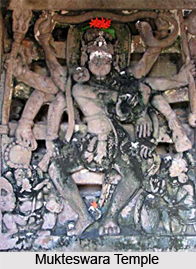
Nataraja sculpture of Mukteswara temple
Another specimen of an image of Nataraja now housed in one of the small temples standing in a row in the compound of the Mukteswara Temple is ascribed to the 6th century AD. The image holds in the upper most two hands a snake with the raised hood shown towards the head. A halo surrounds the head of the image; a third eye is placed on the forehead. Other things which are present with the image are a sacred thread, a waist chain and a belt tied to the body between the waist and the chest. In this image nudity of Nataraja is absent. The Nataraja image of Mukteswara Temple has ten arms. The image is surrounded by Lord Ganesha and an attendant with a musical instrument.
 Nataraja sculpture of Bharateswar Temple
The earliest Hindu Temples of Orissa dedicated to Lord Shiva were built during the early 7th century AD. During this period, the prevalence of dance is indicated by the dancing Shiva images. In one of the three early temples namely Bharateshwar there is a twelve armed Nataraja image. This particular image takes a stance which is almost identical to the chauka of Odissi dance. Two hands, one right and another left are thrown staff-life to the right in Arala hasta and two hands in Ardhapataka hasta are placed on the respective thighs. In the uppermost two hands a serpent is held. Other hands are shown in Musti, Arala and Samdamsa hasta holding different objects, such as, damaru, etc. The bull Nandi is seen lying on the right unperturbed by the dance.
Nataraja sculpture of Parashurameswar Temple
A similar Nataraja image is seen on the front facade of the Parashurameswar Temple with little difference in the position of hands. The image is of ten arms and in one of the left hands Pataka Hasta is held and a right hand is thrown over it like a staff falling downwards on the wrist. The position of these hands is one of its kinds in Orissa. The face is calm and meditative, indicating Sattwika Bhava. A relief figure of Dancing Shiva with eight arms is carved in a niche on the facade of the Parashurameswar temple. Another archaic feature of this representation is the absence of the differentiation of the upper arms and shoulders, the lower arms being depicted in the manner of the spokes of a wheel.
Nataraja sculpture of Satrughaneswar Temple
Two Nataraja images found in the niches of the Satrughaneswar Temple present two unique poses of dancing Shiva. One is a much mutilated figure and occurs on the southern side in a niche. The six armed Natarja holds a trisula in the upper hand and rosary in the lower hand. One hand is broken. In the three hands on the left he holds a looking glass in the upper one and it displays a simhakarna pose with the middle one. A branch with leaves, flowers and fruits is held in the third hand. The bull Nandi is near the right foot with its face turned upwards. A snake raises its hood through the ear-ring. The face is meditative and calm.
 The other figure of Nataraja is found on the northern side of the temple. The ten-armed dancing Shiva portrays a unique stunt of dance. In the motion the weight of the body is thrown on the right leg, the trunk and the body being inclined to the left to form a beautiful pose in tribhanga. The upper two hands hold a snake. The next right hand is on the thigh and the next one is broken. In the next two, are held a rosary and a danda respectively. In the left side, three of the hands are broken, and in the hand next to the uppermost one holds a trisula to which an axe blade is also attached. On the right corner Lord Kartikeya on his pea-cock is found in dancing attitude.
Nataraja sculpture of temples in Bhubaneshwar
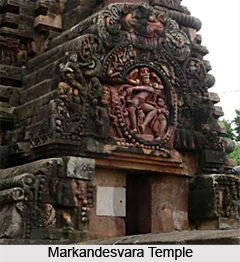
Three early temples of Bhubaneshwar namely Viatala, Markandeswar and Sisireswar assigned to the Bhauma period present three Nataraja images of similar design. The temples have been closely related to each other not only by the same types of architectural dispositions but also by the same designs of sculptures of which the Natarajas with their surrounds at once serve to establish their co-relation. The ten armed Natarajas occupy the front facades and are found within the medallions with borders of beads enclosed by the ornamented Chaitya arches.
A unique figure of Nataraja is seen in the dilapidated temple of Sukleswar in Cuttack District. The image carved on a circular slab of stone perhaps adorned the front facade of the temple. One striking difference it project is that no snakes is held above as in the case of Bhubaneshwar Natarajas.
A striking image in a unique pose of tandava adorns the temple wall of Chandeswar Temple in Ganjam District of Orissa and this is the only type found in Orissa. The Nataraja ascribed to the 7th century AD raises his left leg that clings to the thigh in a characteristic pose of tandava which far excels the poses of all other Nataraja figures both in vigour and rhythm. The face of the eight-armed figure is mutilated. In the uppermost two hands a serpent is held and two other hands are in common posing of tandava. In one of the four hands a damaru is held.
Features of Nataraja sculptures in temples of Orissa
The Orissa Nataraja bear no resemblance with the much-famed South Indian bronze image, where Shiva is seen dancing on a dwarf demon. The Orissa Natarajas present various poses with various hands. Most of the images occupying the front facades are ten-armed. Others occupying the grill, the niches or walls are two-armed, four-armed or six-armed. The images in the temples of Rajarani, Mukteswar, Lingaraj and Megheswar at Bhubaneshwar and Jagannath at Puri are all six-armed. In all cases the feet rest in suchi pada, the body in anchita, lalita or karihasta karana. The Natarajas dance either on the back of a bull or on a pedestal with the bull standing in between the legs. The hastas remain in pataka, ardha pataka, Kapitha, arala, sarpasira, alapadma, ardha Chandra and musti. In some cases Goddess Parvati, the consort of Shiva is seen either sitting or standing by the side of Natarajas.