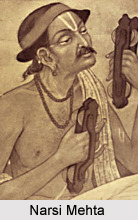
 Narsinh Mehta, also known as Narsi Mehta or Narsi Bhagat, was a poet saint of Gujarat, India and an exponent of Vaishnava poetry. Being the first Vaishnava poet saint of Gujarat, he is revered in Gujarati Literature as its "Adi Kavi", which in Sanskrit means "first among poets". His bhajan "Vaishnav Jan To" was Mahatma Gandhi`s favourite and has become synonymous with the poet"s name.
Life History of Narsinh Mehta
Narsinh Mehta was born at the present city and municipality of Talaja, in the Indian state of Gujarat. He later moved to Junagadh (then Jirndurg) in Saurashtra, Gujarat. He lost his parents at the age of 5 and could not speak until the age of 8. He was raised by his grandmother Jaygauri.
He married Manekbai probably in the year 1429 and stayed together with her at his brother Bansidhar`s home in Junagadh. However, Bansidhar`s wife (his sister-in-law or "bhabhi") did not welcome Narsinh well. An ill-tempered woman, she always taunted and insulted Narsinh for his devotion and spiritual inclination (Bhakti). One day, when Narsinh had enough of these taunts and insults, he left the house and went to a nearby forest in search of some peace, where he fasted and meditated for seven days by a secluded Shiva "lingam", until Lord Shiva himself appeared before him in person. On his request, the Lord took him to Vrindavan and showed him the eternal "raas leela" of Lord Krishna and his Gopis. A legend has it that the poet, transfixed by the spectacle, burnt his hand with the torch he was holding, but was so engrossed in his ecstatic vision that he was completely oblivious to the pain. Mehta, as the popular account goes, at Krishna`s command, decided to sing His praises and the nectarous experience of the "rasa" in the mortal world made him resolve to go on and compose around 22,000 "kirtans" or compositions.
After this divine experience, the transformed Mehta returned to his village and touched his sister-in-law`s feet in reverence, thanking her for insulting him for had she not made him upset, the above episode would not have occurred.
In Junagadh, Mehta lived in poverty with his wife and two children, a son named Shamaldas and a daughter for whom he had special affection, Kunwarbai. He revelled in devotion to his heart`s content, along with the "sadhus" and saints, and all those people who were "Harijans" (Lord Vishnu`s subjects), irrespective of their caste, class or sex. By that time, Narsinh had already sung about the "raas leela" of Radha and Krishna. The compositions are collected under the category of Shringar compositions. They are full of intense lyricism, based upon pastimes of conjugal love between the Supreme Lord and His most intimate devotees, the Gopis, and are not without allegorical dimensions.
Narsinh Mehta went to Mangrol where, at the age of 79, he is believed to have passed away. The crematorium at Mangrol is called `Narsinh Nu Samshan`, where one of the sons of Gujarat and more importantly a great Vaishnav was cremated. He will forever be remembered for his poetic works and his devotion to Lord Krishna.
Literary Works of Narsinh Mehta
Narsinh Mehta is a pioneer poet of Gujarati literature and is known for his literary forms "Pada", "Akhyana" and "Prabhatiya". Mehta`s works are not available in the language in which he had composed them and have been largely preserved orally. The oldest available manuscript of his work is dated around 1612, and was found by the noted scholar K. K. Shastri from Gujarat Vidhya Sabha. Because of the immense popularity of his works, their language has undergone modifications with changing times. Mehta had written many "bhajans" and "aartis" for Lord Krishna, and they are published in many books. His literary compositions include autobiographical works like "Putra Vivah", "Mameru", "Hundi", "Har Same No Pada", "Jhari Na Pada" and compositions depicting acceptance of Harijans. They also include miscellaneous narratives such as "Chaturis", "Sudamacharita", "Dana Leela" and episodes based on Srimad Bhagwatam. These are the earliest examples of Akhyana, the literary narrative type of compositions found in Gujarati. Also in his compositions are the songs of Shringar, which are hundreds of "padas" dealing with the erotic adventures and amorous exploits of Radha and Krishna, like the "raas leela". Various clusters of "padas" like "Rasasahasrapadi" and "Shringar Mala" fall under this head, their dominant note being erotic.
Related Articles:
Gujarati Literature
Vaishnava Literature
Vrindavan
Lord Krishna
Gopis
Radha
Vaishnavism
Gujarati Theatre
Folk Theatre in India