 The subject matter of narrative poems is mainly (1) Mythological and Religious (2) Historical, and (3) Legendary. The poets have tried to give a new interpretation to such stories.
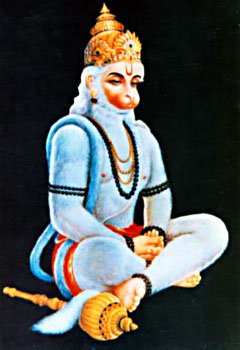
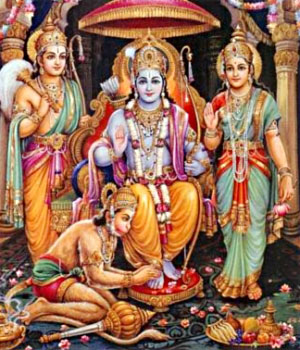
Ramdut in 1966 by Srimant Kumar Vyas, in 14 small `sargas`, is about Lord Hanuman and his deed, based on the Ramayana story, and is the only Rajasthani poem of its type. The poem starts with Hanuman, in the disguise of a Brahmin, meeting Ram and ends with his showing Lord Rama and Sita in his heart in the court at Ayodhya. The poet presents a compact and comprehensive picture of Lord Hanuman in this poem.
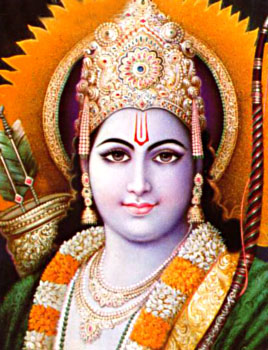
Ram Katha in 1966 by Viswanath or Vimales` divided into five `adhyayas`, retells briefly the story of Lord Rama from His birth to coronation at Ayodhya It is the only poem in this style and is in easy Rajasthani with colloquial influence of Sekhawati.
 Lankan Dhani in 1976 by Nanuram Sanskarta is about Ravana, presenting the lofty side of the Ravana legend. Ravana has been presented as a great patriot, scholar and a person of lofty character. The poem starts from Surpankha`s complaint to Ravana about her humiliation at the hands of Ram and Laksman and ends with Ravana`s death on the field of battle. Lord Shiva calls Ravana`s death the departure of one of the noblest symbols of humanity. Vibhalsan has been characterised as a devotee of Ram but a traitor to his homeland. Sacrifice for one`s own land has been eulogized. Though the poet has tried to give a new orientation to the Ravana legend, the effort has failed to create the desired impact because of the prevailing traditional sentiments about Ramayana. The poem is in six `sargas` and in easy Rajasthani.
Manohar Sarma`s contribution in this respect is remarkable. His Kunjan is a poem on separated lovers, on the model of Meghdut. A prince in love, belonging to Bikaner, sends home messages to his beloved through a bird known as Kunjan. Through the description of the bird`s flight, the geography of Rajasthan with relevant historical background is given.
His Gopi Git is in the tradition of Bhramar Git poetry and deals with Nirgun and Sagun-bhakti and purity of love. Marwani is based on the folk love tale of Dhola-Maru.
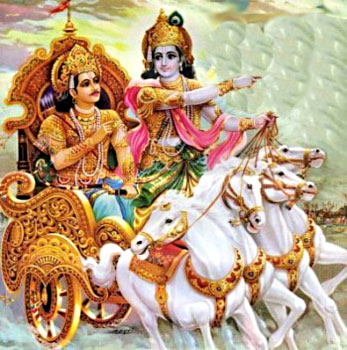 Amarphal and Antarjami by Manohar Sarma are based on the Katha Upanishad and Ken Upanishads. Amarphal tells the story of Nachiketa and his attaining Atmagyan from Yamraj. Objects of Nature have been presented as symbols of different emotions. Indra, the hero of Antarjami, has been presented as a symbol of modern man. The poem in fact is a thought-provoking poem.
Satyaprakas Josi`s Radha written in 1960 portrays Radha`s boundless love in a new context. It is not limited to her and her joy and pain. She tries to protect Lord Krishna from devastation in the battle of Mahabharat and asks him to spread the constructive message of prosperity and peace. The poem appears to be influenced by Kanupriya of Dharmvir Bharati.
Barhat Karanidan`s Sakuntala in1974 is based on the mythological story but offers a new interpretation. It emphasizes the feminine self-respect. His other poem is Sri Ram Sati in 1975 based on the popular story. Rani Sati is worshipped as a folk goddess, whose temple is at Jhunjhunuri.
 Maru Mayank in 1961 by Kanha Maharsi narrates the life and work of Ramdevji Tanwar, one of the famous five folk gods of Rajasthan. He is worshipped for his benevolent deeds and miraculous powers. But, in this poem, he has been presented as a social worker who gives up his claims to ancestral property and works for social uplift and eradication of untouchability.
Miran in 1976 by Narayansinha Bhati is about Miranbai. The emphasis is on Miran`s emotions and her pathetic circumstances. There are occasional descriptions of nature in the context of varying human moods. Miran`s love is for Lord Krishna, the Absolute. The poet has not neglected the historical tradition though there are occasional lapses. The language is sometimes clumsy and renders some passages unintelligible.
Delyan ko Diwalo in 1963 by Banwarilal Miira `Suman` narrates the life and deeds of Rana Pratap. It starts from `jauhar` of Rani Karma and other women and Panna Dhay`s sacrifice of her son in order to save Udaysinha. It is a poem of vir ras written in fluent Rajasthani in a forceful way with effective imagery.
Dharati written in 1976 by Suryasankar Parik describes realistically the rural Rajasthan life, its customs, traditions and culture, its daily life, joys and sorrows in the context of nature and seasons. It is purely a descriptive poem, not based on any connected story. The language is unsophisticated Rajasthani.
Piv Bandhav rai Bhekh was written by Kalyan Gautam in 1978. It is a simple narrative poem. The poem is based mostly on folklore; it tells the moving story of a young Rajput husband who gives a pledge to a moneylender to treat his wife as his sister till he pays off the loan of two thousand rupees which he had taken to bring his bride home. After faithfully keeping his pledge through a period of hardship, he pays off the debt through the generosity of the queen of Chittore in whose household the couple had taken up service.
Thus it can be inferred that narrative poems belonging to Medieval Rajasthani Literature mostly give vivid descriptions of various historical and mythological incidents.