
Nada Bindu Upanishad is one of the `minor` Upanishads and is considered as a part of the Rig Veda. Prarabdha is employed in the Nada Bindu Upanishad verse. The Rajasic and Tamasic qualities, its feet upwards (to the loins); Sattva, its (main) body; Dharma is considered to be its right eye, and Adharma, its left. The Bhur-Loka is situated in the feet; Bhuvar-Loka in the knees; the Suvar-Loka, in loins; and the Mahar-Loka, in navel.
Janaloka is situated in the heart. Tapoloka is situated in its throat and the Satya-Loka in the centre of the forehead between the eyebrows. Each of these Matras has three parts which is called Omkara. The first Matra is Ghoshini; the second, Vidyunmali , the third, Patangini; the fourth, Vayuvegini; the fifth, Namadheya; the sixth, Aindri; the seventh, Vaishnavi; the eighth, Sankari; the ninth, Mahati; the tenth, Dhriti (Dhruva); the eleventh, Nari and the twelfth, Brahmi.
If a person happens to die in the first Matra it is considered as he is born again as a great emperor in Bharatavarsha. If he dies in the fifth, Ardha-Matra, he lives in the world of the moon. In the eighth he becomes the Lord of all creatures. When the mind goes beyond the Gunas and is absorbed, it has no separate existence and no mental action. A person who is always engaged in its thought and absorbed in it should leave off his body following the course of Yoga. Then he is freed from the bonds of karma and the existence as a Jiva. It is seen that even after Atma-Jnana has awakened Prarabdha does not leave him.
As clay is a material cause of the pot so that one learns from Vedanta that Ajnana is the material cause of the universe. As a person through illusion mistakes a rope for a serpent, so the fool not knowing Satya (the eternal truth) sees the world (to be true). When he knows it to be a piece of rope, the illusory idea of a serpent vanishes.
The Yogin being in the Siddhasana posture should always hear the internal sound. The sound that he practises makes him deaf to all external sounds. The mind at first concentrated on any one sound that fixes firmly to that and is absorbed in it. It becomes insensible to the external impressions. One after having abandoned all thoughts and being freed from all actions, should always concentrate his attention on the sound and his Chitta becomes absorbed in it.
Nada Banda Upanishad
Nada Banda Upanishad is the thirty eighth among the one hundred and eight Upanishads. It deals with the attainment of Videha-mukti.
Recently updated articles in Indian Philosophy
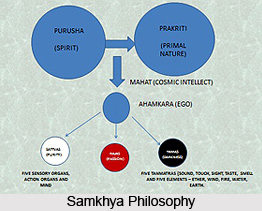
Samkhya Philosophy
Samkhya philosophy is one of India’s oldest intellectual traditions, explaining reality through the interplay of Puruṣha (pure consciousness) and Prak...
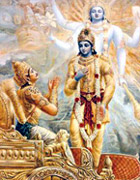
Maya, Prakriti in Hinduism
Maya or illusion is a very potent instrument of the Divine Prakriti, the Primal nature. In Hinduism one must be able to come out of Maya in order to a...

Samadhi in Hinduism
Samadhi is the result of meditation or that state of mind when there is an absence of all idea of individuality.
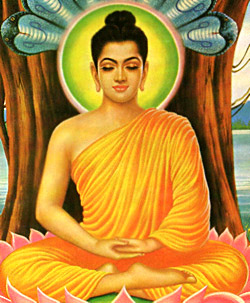
Samadhi in Buddhism
According to Buddhism, oen can only achieve samadhi through strict meditation and right concentration.
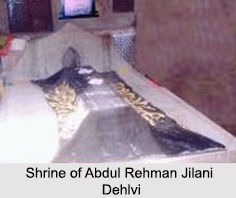
Abdul Rehman Jilani Dehlvi
Syed Abdul Rehman Jilani Dehlvi was a renowned Sufi saint of the Qadri Order in India.
Related articles in Indian Philosophy

Ajivika Philosophy
Ajivika philosophy is different from the mainstream religion

Indian Philosophy In The Vedic Period
Indian Philosophy in the Vedic Period was primarily based on the concepts of nature worship.
Achintya Bheda Abheda Philosophy
Achintya-Bheda-Abheda is a School of Vedanta that represents the philosophy of unimaginable one-ness and difference in relation to the power creation...
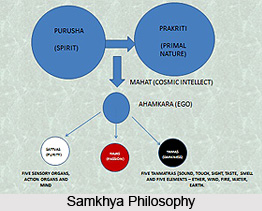
Samkhya Philosophy
Samkhya philosophy is one of India’s oldest intellectual traditions, explaining reality through the interplay of Puruṣha (pure consciousness) and Prak...
Charvaka Philosophy
The Charvaka Philosophy believes that only those things that can be perceived is the ultimate reality.