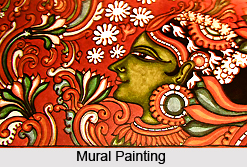
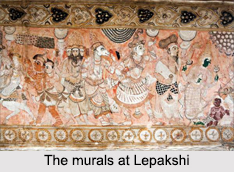
 Murals of Lepakshi are among the most excellent displays of the murals and paintings of Karnataka in the Vijayanagara period. It is one of the largest murals still painted in Asia at the Veerabhadra temple at Lepakshi in Andhra Pradesh in South India. The murals of here are the complete of liveliness.
History of Murals in Lepakshi
Following the Badami murals, the next major works of painting are seen in the Vijayanagara period in the 15th-16th centuries. Lepakshi is regarded as very significant for its historical, archaeological and visual value. These murals were first noticed by A. H. Longhurst in 1912-13. It has the initial conserved cycle of mural paintings in the Vijayanagara style and offers a small number of lessons to the art historians for the conservation and re-establishment of traditional arts.
The Veerabhadra temple was built in the 16th century, during the command of King Achuta Deva Raya. The significance of these murals lies in that they provide a link in history of paintings in Karnataka. These murals are found depicting scenes from the epics and the Indian Puranas. The murals are found in the high ceilings of the huge gateways of the Veerabhadra temple. The ceiling is divided into a number of strips and the individual strips are broken into square or rectangular panels. Each one of the panels depicts a particular scene, or part of one, in keeping with the theme of representation in the central panel. It is seen that most of the murals deal with themes and figures from mythology. There are a number of panels which are depicting the Gods- Lord Shiva, Lord Vishnu, as well as other mythological characters like Arjuna etc.
Features and Themes of Murals in Lepakshi
The utilization of natural colours and early mural arts makes Lepakshi an amazing stockroom of skills on the edge of death. The birds, beasts and plants depicted in its paintings and carving has generated a style often found today in block-printed Indian textiles and rugs. The Lepakshi temple"s paintings depict the incarnations of Vishnu. There are also murals dedicated to figures yet unknown, most likely Kings and Queens of that time. Most of the figures depicted here have been drawn in sketch; a style which seems to have been preferred by the artists of the time. The panels are bordered with decorative margins on four sides, which go very well with the central panel. A decorative style has been adopted in executing these works. The figures in front are well captured due to the light shade of the background. The nature of line work is different from usual folk paintings. Sometimes, the facial profiles or some dark costumes may not have a line at all at the edges. It may be noted that, the costumes are never left blank and without any design and all of them are shown with decorative patterns.
Another prominent aspect of the figures is that the profile figures are shown tilting backwards, from the feet upwards till the waist and then again forward from the waist to the neck. The head stands erect. In terms of both the brush work and the lines, the parts do not attain unity with the total figure. Most of the murals deal with mythological figures and themes. In one of the panels, Lord Shiva can be seen riding a bull with his consort Uma.
The human figures can be seen wearing dhotis and sarees but standing bare above the waist. They are adorned with a full body of jewels, including crowns, necklaces, bangles etc. A four-armed God is seen standing before a tree in full blossom in another one of the panels. There are many panels which depict different scenes. One of the larger panels depicts Lord Shiva destroying the three cities.
Another popular topic is, the depiction on a number of panels here is the story of Arjuna`s archery feat through which he won Draupadi as his wife. In another long panel, the ten avatars of Lord Vishnu are shown in a series and most of these figures have been drawn in the favoured profiles. The only exception here is Narasimha. There is a scene of battle below the panel where chariots drawn by elephants and horses are shown meeting face to face. One of the panels clearly illustrates a Hindu King being attended to by a person in a Muslim costume. Warriors are both Indian as well as European, and some are seen holding guns and bayonets.
They are outstanding pieces of the Vijayanagara architectural style and their colour and composition is remarkable to observe. It has been observed that, most of the murals have been retraced in the later periods. These later additions of colour are bold and contrasting and the lines have been too strongly touched up. However, the original figures have retained their old posture and the magic of the murals in Lepakshi remains intact.