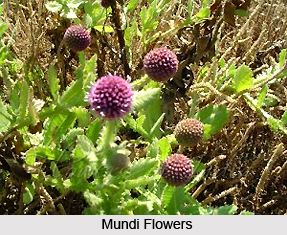
 Mundi is recommended as an Indian Medicinal Plant. This herb is known by the botanical name Sphaeranthus indicus. This medicinal plant has local names such as: chagulnadi, ghorkmundi, gorakhmundi, mundi and murmuriya in Bengali; bodiokalara, gorakhmundi or mundi in Gujarat; gorakhmundi or mundi in Hindi; bodu kadale soppu in Kannada; atakkamaniyan, attakkamanni or mirangani in Malayalam; barasavodi, gorakhamundi and mundi in Marathi; bokashungi, buikadamba and murisa in Oriya; ghundi, khamadrus, mundibuti and zakhmihaiyat in Punjabi; hapusa, mundirika or sravani in Sanskrit; kottakaranthai or kottakkarandai in Tamil; bodasoram, boddasoramu, and boddatarupu in Telugu; kamdarvus and mundi in Urdu. This Indian medicinal plant is distributed widely in the damp habitats throughout India. Mundi grows at lower elevations and is also available to an altitude of 1500 m in northern India.
Mundi is an aromatic herb and reaches up to 30-60 centimeter height with glandular-hairy stems and branches. The stems come with toothed wings. All the leaves are arranged in the sessile, decurrent and they are 1 to 5 centimeter long and 0.4-2.2 centimeter wide the leaves comes with an obovate-oblong shape. At the apex, each leaf is rounded or subacute. At margins, the leaves are spinous-serrate or dentate and narrow down at the base with glandular-hairy. Indian medicinal plant, Mundi, produce purple florets that borne in compact globose-ovoid heads. They are within 1-1.6 centimeter in diameter on glandular peduncles with toothed wings. The involucral bracts in the Mundi are linear, acuminate, pubescent and ciliate near the ends. The achenes are glabrous and stalked.
Mundi is one of the indispensable medicinal plants. All parts of the plant are used for medicinal purposes. In Ayurveda, this plant has attained a great position for its remedial attribute. The whole plant is used to treat various diseases including anorexia, jaundice, and diseases of the spleen, piles, worm infestations, blood disorders, oedema, scrofula, filariasis, elephantiasis, dysuria and fever.
Mundi has been used to treat serious ailments by the Ayurvedic physicians in Kerala. This Indian medicinal plant play as the main ingredient of Hapusa, a drug used to improve digestion and to treat abdominal tumours, indigestion, colic, piles, hydrocele, diarrhoea, impotence, leucorrhoea and skin conditions. Mundi is also considered as a tonic, laxative and emmenagogue, and is used to treat sore eyes, jaundice, gleet, biliousness, boils and scabies. The oil from the root of this Indian medicinal plant is regarded as aphrodisiac and is used to treat prolapsusani. In Siddha practise, the root, leaf, flower and seed of Mundi are used to treat eczema and other skin diseases, worm infestations, piles and as an aphrodisiac and rejuvenator. The juice of the crushed plant, Mundi is styptic and believed to be useful for treating liver and gastric disorders. An infusion of this Indian medicinal plant is given as an anthelmintic and also as a blood-purifier among the tribal inhabitants of eastern Bihar.
The paste of the herb Mundi, made with oil, is applied externally to relieve itching. The powdered seeds and roots of Mundi are given as an anthelmintic. A decoction of the root is used to treat chest pains, cough and bowel complaints. The root bark, mixed with whey, is said to be useful as an application for piles. Among the Kondhs of southwestern Orissa, the dried, powdered root, mixed with ground black pepper, is used to treat dysentery. Flowers of this Indian medicinal plant are credited with alterative, cooling and tonic properties. They are reportedly eaten to treat conjunctivitis. A decoction of the leaves and flowers is used by the Irulars in Tamilnadu for its cooling effect. The leaf juic of Mundi is boiled with milk and sugar and is prescribed for cough. The leaves of Mundi are edible and used as a pot-herb.