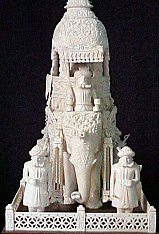
 Metal embroidery, a popular embroidery style in Rajasthan, primarily found its patrons in the royalty and the well-to-do merchant classes who wore ornately adorned apparels. They preferred gorgeous garments abundantly embroidered in gold and silver because embroidery was thought to be auspicious and also because it represented wealth, power and importance. The royalty were so impressed by this style of ornamentation that they often employed it on a wide range of fabrics other than apparel, like footwear, belts, caps, cushions and even on elephant caparisons and canopies. The embroidery on these garments is, sometimes, so extravagant that the surface of the ground fabric cannot be differentiated.
Types of Metal Embroidery
Metal embroidery can be classified into three kinds, zardozi, gota work and danke-ka-kaam.
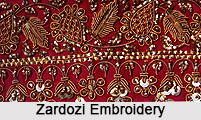
Zardozi Embroidery: Zardozi embroidery is in existence since the time of the Rig Veda. Later, it was used to adorn the attires of Kings and the royals in India. It was also used for various decoration purposes. This embroidery work involves making elaborate designs, using gold and silver threads. Gold and silver are strained through a series of dies to obtain a fine thread. This can either be hammered flat or used as they are found. It could also be enveloped around a silken or cotton filament core to manufacture the thread. Nowadays, electroplating with other metals also achieves a similar effect; this process is also widely used in Rajasthan.
Gota Work: This embroidery originated in Rajasthan. Gota is a gold or silver lace from Lucknow. Various coloured ribbons of varying width, woven in a satin or twill weave may also be referred to as gota. Gota embroidery is crafted using appliqué technique. It is used along with kinari work. In the earlier days, real gold and silver metals were used in Gota embroidery. Later, the embroidery workers started using copper coated with silver as the genuine way of making it was very expensive.
In the state of Rajasthan, people wear attires with Gota work during festivals and at auspicious functions. Gota embroidery can be observed mainly on dupattas, turban edges and ghagras.
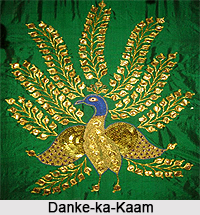
Danke-ka-Kaam: Danke-ka-Kaam, earlier known as korpatti-ka-kaam, is a speciality of Udaipur, a small city of Rajasthan. The danka is a small square plate, which is variable in size but is not bigger than 1.5 cm. Earlier, danka was made from pure gold but nowadays, it is made using silver plated with gold. This technique is usually worked on fabrics like satin, chiffon or silk fabric. The most popular motifs used in Danke-ka-kaam are inspired by nature.