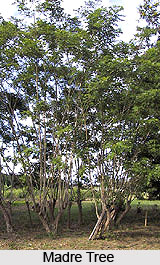
 Being another proud and gorgeous member of the `Leguminosae` family, the `Madre Tree` is a very nice tree with some long sprays of pale pink flowers. The scientists of the world know it as `Gliricidia Sepium`. The name of its sub family is `Papilionaceae`. The name `Gliricidia` means, "rat destroying" and it is claimed that the seeds of this tree have this special power. In Tamil, the tree is known as `Kona Maram` and in Sinhalese it is called `Maikonagaha`. It has quite a few names in English. They are: the `Madre`, `Spotted Gliricidia`, `Madre de Cacao` and the `Nicaraguan Cocoa Shade`.
The `Madre Tree`is not that very old to the Indian people. The Madre can develop into a nice spreading tree. The long grey branches of this tree sweep out and downwards in elegant arches. However, because of bearing a large amount of leaves, these branches often break down by the weight of those leaves if the tree stands in a spot lonely from the wind. This causes an entire change in the form of the tree. A tree bears numerous flower-bearing branchlets in its main branches. It can reach the height of 7.5 to 10 cm. Each of the branchlets is clothed with a dozen or so flower sprays. From the scars of the tree raise numerous, very long branches. They remain enfolded with clusters of pink bloom. The months of January and February is the flowering season of this tree. Before most of the leaves fall, the remaining shows off the delicate paleness of the blossoms. If a `Madre Tree` gets dark background it can be seen at its best - an evergreen for instance. When the flower and plants are only about a meter high, they grow very quick and also propagate easily.
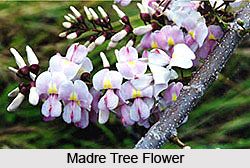 The flower sprays are about 15 cm. In length and tightly covered with pale purple-pink blossoms. One petal is large and curvy on the backside and within the two sickle-shaped wing petals; there is an incurved keel petal. The upper petal is filthy with yellow colour. The fruit of the tree is a long flat "bean" and in the month of March, the whole tree becomes clothed with these pendent green pods and that makes quite a charming sight. The leaves of the `Madre Tree` are about 30 cm in length and divided into eight pairs and one terminal leaflet. They are pale green in colour, soft and furnished above. When they fall down and wither, they smell like new-mown hay. The tree has no medicinal or economic uses in India.