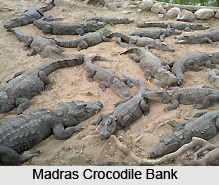
 Madras Crocodile Bank Trust and Centre of Herpetology or MCBT is also referred to as `Croc Bank` and is located at a distance of 40 kms away from the southern portion of Chennai in Tamil Nadu. It is an important research spot for herpetology and reptile zoo. The idea of establishing this crocodile preservation centre was conceptualised and planned by Romulus Whitaker, the legendary herpetologist who commenced work on the trust in the year 1976. The Madras Crocodile Bank Trust was erected in order to safeguard the swiftly diminishing population of crocodiles in the country. Currently, this organisation has made an excellent contribution to the sphere of conservation of elephants, after a period of 30 years.
The Madras Crocodile Bank Trust is recognized by the Wildlife (Protection) Act, 1972 and plays a very important role in enabling the systematic research, education and herpeto-faunal preservation. This centre is the oldest crocodile breeding centre in the continent of Asia and is governed by the Central Zoo Authority and the Ministry of Environment and Forests, Government of India. Madras Crocodile Bank Trust aims to protect the various endangered species of crocodiles including `Gharial`, `Saltwater Crocodile`, `Mugger Crocodile` and so on, since these very species were about to be extinct when the trust was established. The Ford Conservation and Environmental Grant Award was granted to the Croc Bank in the year 2001 for `Integrated Environment Education` Project.
History of Madras Crocodile Bank Trust
During the latter part of the 19th century, the regional harvesting of crocodiles increased to a large extent for the global demand of luxurious fashion equipments derived from skins and other body parts of crocodiles. Crocodiles were hunted indiscriminately and within 1970`s, the number of crocodiles underwent a phenomenal decrease and they nearly became extinct. Therefore the Government made a goal to preserve crocodiles under Wildlife (Protection) Act, 1972. In 1976, Madras Crocodile Bank Trust was set up by the Rom and Zai Whitaker to safeguard the endangered species of crocodiles. By the 1990`s, there were about 8, 000 crocodiles inside the Madras Crocodile Bank Trust and currently there exist 18 species of crocodiles and three of these species have been categorised as critically endangered crocodiles by the IUCN or International Union for Conservation of Nature and Natural Resources.
Gradually, more animals were introduced into the Madras Crocodile Bank which included snakes, lizards and turtles. In the year 2003, it was called the Madras Crocodile Bank Trust and Center for Herpetology and today the Croc Bank gives great emphasis to the preservation of nature since its development. With the passage of time this organization has become an internationally acclaimed institution, thanks to the support and cooperation extended by the Government and the communities.
Fauna of Madras Crocodile Bank Trust
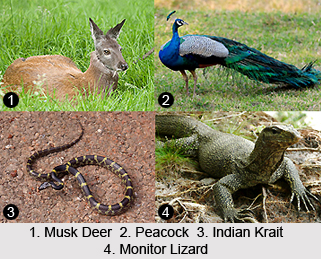
There are many species of crocodiles which are existent in the Madras Crocodile Bank consisting of American Alligator, Saltwater Crocodile, Dwarf Caiman, West-African Dwarf Crocodile, Gharial, Siamese Crocodile, Australian Fresh-Water Crocodile, Morelett`s Crocodile, Marsh Crocodile, Common Caiman, False Gharial, African Slender-Snouted Crocodile, Yacare Caiman, Nile Crocodile, etc. Indian Roofed Turtle, Red-Crowned Roof Turtle, Aldabra Giant Tortoise, Indian Star Tortoise, Travancore Tortoise, Crowned River Turtle, River Terrapin, Indian Flapshell Turtle and Indian Soft Shelled Turtle, Spectacled Cobra, Reticulated Python and Indian Rock Python are all existent here.