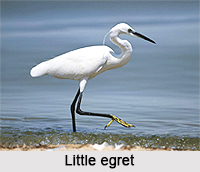
 Little egret is an Indian bird with a scientific name "Egretta garzetta" is a small white heron. It is the Old World counterpart to the very similar New World snowy egret. In Botswana, it is known as the yellow-footed egret.
Classifications of Little Egret
Little egret has been classified as subspecies of the little egret. In the past Little egrets are regarded as two separate species.
Concentration of Little Egret
These are the Little egret "Egretta gularis" which occurs on the coastline of West Africa (Egretta gularis gularis) and from the Red Sea to India (Egretta gularis schistacea), and the dimorphic egret Egretta dimorpha, found in East Africa, Madagascar, the Comoros and the Aldabra Islands.
Structure of Little Egret
The adult little egret is 55-65 cm long with an 88 to 106 cm wingspan, and weighs 350-550 gram. Its plumage is all white. The subspecies garzetta has long black legs with yellow feet and a slim black bill. In the breeding season, the adult has two long nape plumes and gauzy plumes on the back and breast, and the bare skin between the bill and eyes becomes red or blue.
Juveniles of Little Egret
The Juvenile Little egrets are similar to non-breeding adults, but have greenish-black legs and duller yellow feet. Little egret has yellow feet and a bare patch of grey-green skin between the bill and eyes. The subspecies nigripes differs in having yellow skin between the bill and eye, and blackish feet. Little egrets are mostly silent but make various croaking and bubbling calls at their breeding colonies and produce a harsh alarm call when disturbed.
Feeding of Little Egret
Little Egrets eat fish, insects, amphibians, crustaceans, and reptiles. They stalk their prey in shallow water, often running with raised wings or shuffling their feet to disturb small fish. They may also stand still and wait to ambush prey.

Breeding of Little Egret
The breeding distribution of Little Egret is in wetlands in warm temperate to tropical parts of Europe, Africa, Asia, and Australia. In warmer countries, most of the Little egret birds are permanent residents; northern populations, including many European birds, migrate to Africa and southern Asia. They may also wander north in late summer after the breeding season, which may have assisted its current range expansion. Globally, the little egret is not listed as a threatened species.
Eggs of Little Egret
The three to five eggs of Little Egret are incubated by both adults for 21-25 days to hatching. They are oval in shape and have a pale, non-glossy, blue-green colour. The young birds are covered in white down feathers, are cared for by both parents and fledge after 40 to 45 days.
Nests of Little egret
Little egret nests in colonies, often with other wading birds, usually on platforms of sticks in trees or shrubs or in a reed bed or bamboo grove. In some locations such as the Cape Verde Islands, they nest on cliffs. Pairs defend a small breeding territory, usually extending around 3-4 m from the nest.