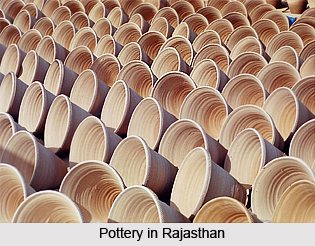
 Kumhar is the community name for the village potter, an essential member of rural society, who supplies all the earthen vessels required for cooking and storage. The Kumhar can be divided into a number of exogamous divisions. Both Hindu and Muslim Kumhars live in the same region. According to the old Indian mythology, the Kumhar are offspring of Lord Braham (Prajapati). Due to this reason, the Kumhars of some places in India use `Pajapati` or `Prajapati` as a surname as per the Indian caste system.
The Kumhar can be found throughout India by different surnames like Verma, Kumhar, Prajapat, Prajapati and Kumawat. The basic occupation of the Kumhars is making earthen pots. It has also been said that the Kumhars are the first inventors of the wheel or cycle which are used to make earthen utensils. The Kumhars are the believers of Hindu deities basically Lord Shiva and Mother Goddess (Mata).
The dressing style of the Kumhar women is much alike the Gujjar women. Their `kanchli` is similar to the Maheshvari `kanchli`. It ends just below the bust, with a bare back and short sleeves just above the biceps. All women usually wear the `angutha chaap odhna`. This `odhna` has a dull red base and is printed all over with a design of white block printed rectangles. They also wear yellow, red and black `chunri`, which is sometimes embroidered. Its central portion is often ornamented with silver bells. Almost all tribal women prefer to wear jewelleries. Most of the jewelleries are made of brass and they usually wear no silver. They also wear a brass `kada` on the ankle.
The costume of the Kumhar men is quite similar to that of men from other working class communities. The upper garment, called the `bandi`, has half sleeves and a round neck, with buttons on the centre front. Since the Kumhar works squatting on the ground, his upper garments are short. On special occasions silver buttons adorn the `bandi`. At times, the Kumhar men also wear an `angarkhi`. This garment is quite similar the `Jat angarkhi`, except that its sleeves are of elbow length. The lower garment of the Kumhar men is a calf length dhoti worn in the `tilangi` style. Their headgear is a white `gol safa`. They also wear a deep red safa, or a printed turban called `jaipuria` on some occasions. The men are fond of jewellery and wear `murki` in their ears, silver amulets around the neck and a `kadi` on the right ankle. They do not wear `kada` on their wrists, as it would probably hinder their work.
The simplistic yet hard working lifestyle of the Kumhars is the result of the balance in their ethnic and rustic life cycle.