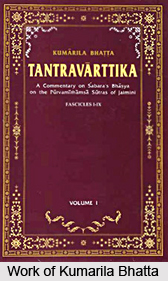
 Kumarila Bhatta (625-75 CE) was a follower of the Purva Mimamsa tradition. He was a realist philosopher whose major works include the Shlokavarttika and Tantravarttika commentaries on Shabara`s commentary on the Mimamsa Sutras of Jamini. Bhatta went to study Buddhism at Nalanda with the aim of refuting Buddhist doctrine in favour of ritualistic Vedic religion. A determined opponent of Buddhism, Kumarila thinks that the individual soul really beyond space and time, is the centre of agency and experience.
Cognitions are formless acts. The non-creative mind is originally a blank slate receiving information via the senses, about a world of objects in cognitions. Cognitions are essentially truthful. Cognitions are assumed to be reliable. Errors and dreams refer to realities experienced elsewhere. According to Kumarila Bhatta there are two varieties of perception: a pre-linguistic and pre-conceptual undifferentiated observation. The absolute validity of the beginning less, authorless and infallible Vedic scriptures command ritual performances follows from the simple fact that they are perceived. They are the means of knowing about that which lies outside experience, revealing something that would otherwise be unknown.
Kumarila accepts that language may express facts as well as things to be done. But the only type of language that is a source of knowledge in its own right is that of the Vedic ritual instructions because the factual is already established by perception and inference. Kumarila thinks that the Vedic imperatives motivate those people who have interest in the assured results of actions prescribed.
In his varttika Kumarila Bhatta goes to great lengths to argue against the theory of a creator and held that the actions enjoined in the Veda had definite results without an external intrusion. In Mimamsa salvation consisted of the attainment of heaven. He is also credited with the logical formulation of the Mimamsa belief that the Vedas are unauthored. His defence against medieval Buddhist position on Vedic rituals is worth mentioning. His work strongly influenced other schools of Indian philosophy that includes Advaita Vedanta, especially as Vedanta adopts purva Mimamsa`s epistemological arguments. Kumarila was determined to rescue Vedic culture from the criticism of the Buddhists.
Kumarila Bhatta argued for a strongly compositional view of semantics. In this view, the meaning of a sentence was understood only after understanding first the meanings of individual words. Words were independent and complete objects.