 Kumarasambhava or Kumaarasambhavam is one of the Sanskrit epic poems written by Kalidasa. Kumarasambhava means the birth of the War God or Kartikeya, Lord Shiva`s first son. It is one of the most foremost and substantial examples of `Kavya` (English: epic poem, refers to artificial Sanskrit literary mode used by Indian court poets prospering from the first half of 17th century A.D.) poetry.
The epic poem Kumarasambhava is divided into seventeen chapters or sargas. They describe the courtship of Lord Shiva and Devi Parvati. The seventeen chapters are said to be Shringar Rasa that is the illustration of love, romance, and sexual desire. It is said that a powerful rakshasa or demon named Tarakasur was blessed that he would be killed by Lord Shiva`s son. However, Shiva had condensed the desire for love by intense meditation. Parvati performed great tapasya or spiritual penance and won the love of Lord Shiva. Later Parvati gave birth to a son named Kartikeya. Kartikeya grew up and killed Tarakasur and restored tranquility and the glory of Lord Indra and the celestial world. This how ends the story of Kumarasambhava.
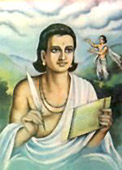
There is a mythical story relating to Kalidasa when he was writing Kumarasambhava. Kalidasa abandoned his home and went away in search of knowledge and become worthy of his intellectual wife Vidyotama. When he returned his wife asked, `asti kashchit wagvisheshah` that means if he had attained any intellect which should prompt her to extend a special welcome to him. Kalidasa wittily gave an appropriate answer to this. He informed Vidyotama that he had created three great epics based on the three letters uttered by his wife, `asti`, `kumarsambhava` and `kashchi`. The three words relates to the three great epics. From "Asti" he produced "Kumarasambhava"; from "Kaschit" he penned "Meghaduta" and from "Wagvisheshah" he wrote "Raghuvansha".
It is believed that Kalidasa was cursed with leprosy when he completed the eighth chapter of Kumarasambhava. In this chapter he described the act of love between Lord Shiva and Parvati. The last part of Kumarasambhava was completed by an anonymous writer.