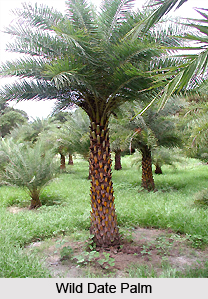
 Kharjuri is biologically known as Phoenix sylvestris and commonly as Date Sugar Palm, Kajuri, Sendi, Ichal, Kattinta, Shindi, Kojari, Khaji, Icham and Eetha in different states of India. Kharjuri tree is common in many parts of India and Myanmar and grows at an altitude of 1500 m either in wild vegetation or under cultivation. The moist, well-drained alluvial soils are preferable for Kharjuri trees and are often found in low-lying sites and streambanks in central India. However, in southern India it often forms dense thickets.
This graceful palm tree is 10-16 m tall with a large crown and rough trunk covered with pushy leaf bases. The Kharjuri leaves are 3 to 4.5 m long, which are greyish-green in colour with a few short spines at the base. Kharjuri tree has numerous pinnules that are linear, 15-45 cm long and 2-2.5 cm wide with short pointed ends.
The flowers of Kharjuri are small, fragrant and borne in spadices. The male flowers are white, while the female ones are greenish. Fruiting spadix of the Kharjuri tree are about 90 cm long, bearing oblong-ellipsoid berries. The berries of Kharjuri are 2.5-3.2 cms long, orange-yellow when ripe and the seeds are approximately 1.7 cm long, which are deeply grooved with rounded ends. Flowers bloom on Kharjuri tree between March and May in most parts of India and the fruits ripen in September and October.
The edible fruits of the Kharjuri trees are considered car-diotonic and constipating in Ayurveda, and are used to treat heart problems, abdominal complaints, fever, vomiting and unconsciousness. The fruits are commonly mixed with almonds, pistachio nuts, quince seeds, spices and sugar and eaten as a stimulating remedy. The seeds of Kharjuri, made into a paste with the roots of Achyranthes aspera are eaten with betel leaf for treating ague.
A paste of the Kharjuri roots of the young plant is given to relieve nausea in southern West Bengal; the roots are also used to relieve toothache. The tender, meristematic portion of the stem is used to treat diseases like gonorrhoea and gleet. The Irular women of Tamil Nadu eat this portion of the tree to relieve pain during the final month of pregnancy. The upper part of the Kharjuri stem bearing older leaves is extracted in many parts of India between October and February for its sap called the nira, which is used as a energizing, sweet, vitamin-rich beverage or converted into jaggery and sugar. The ripe fruits are also commonly cultivated into jams and jellies. The leaves are widely used for thatching and for making mats, baskets, fans and other handicrafts.