 Keeled Box Turtle is an Indian reptile that bears a scientific name "Cuora mouhotii" or "Pyxidea mouhotii" and is a species of turtle in the family Geoemydidae.
Concentration of Keeled Box Turtle
Keeled Box Turtle is native to Asia, where it occurs in China, India, Laos, Burma, Vietnam, Thailand, and Bhutan.
Category of Keeled Box Turtle
Keeled Box Turtle is sometimes treated as the sole species of the monotypic genus Pyxidea. Phylogenetic analysis using mitochondrial DNA has provided evidence that the species is part of the "Cuora group", a monophyletic group of Asian Box Turtles, and the name Pyxidea should probably be synonymized with Cuora, making the Keeled Box Turtle part of that genus. Other phylogenetic studies of Cuora support this conclusion. In addition, its morphology is not distinct enough from that of Cuora species to keep it separate, and it is known to hybridize with Cuora galbinifrons.
Population of Keeled Box Turtle
Keeled Box Turtle has the Southern Vietnamese population. Keeled Box Turtle lives alongside Cuora picturata. Since Cuora mouhotii is known to hybridize with the closest living relatives of Cuora picturata (Cuora galbinifrons and Cuora bourreti) there is a possibility of hybridization in the wild between these two populations.
Shell of Keeled Box Turtle
The upper shell of Keeled Box Turtle has three large, raised ridges and is serrated on the back end. The lower shell of the Keeled Box Turtle has different variations of brown in colour ranging from light brown to dark brown.
Jaws of Keeled Box Turtle
The upper jaw of Keeled Box Turtle is strong while the snout is short and curved. The Turtle"s feet are only partially webbed. The partially webbed feet suggest a terrestrial lifestyle as opposed to an aquatic one.
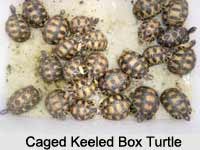 Sexes of Keeled Box Turtle
The male and female Keeled Box Turtles can be distinguished by the colour of their eyes as well as their nails. A male Keeled Box Turtle generally has longer and thicker nails than a female Keeled Box Turtle, and eyes that are either black or brown. A female Keeled Box Turtle generally has shorter, thinner nails and their eyes are orange or red. The males and females of Keeled Box Turtle had an average carapace length of around 15 to 17 centimetres.
Breeding Season of Keeled Box Turtle
The breeding season of Keeled Box Turtle is in May through September. The average clutch size was four eggs, which are smooth, white, and about 4.4 centimetres long. On average they typically lay two clutches in a breeding season. Like many other turtles the Keeled Box Turtle does not care for its young. Females have been noted to dig nests with their rear legs and cover the clutches with soil, and also to lay eggs under fallen leaves.
Behaviour of Keeled Box Turtle
The male Keeled Box Turtle is very aggressive during the act of mating. In some instances the male turtle will chase and injure a female. The male will often persist until the female allows its advances.
Feeding of Keeled Box Turtle
Keeled Box Turtle is herbivorous, and eat wide variation of vegetation in the natural environment, with a preference for wild fallen fruits. They will also occasionally eat worms snails and other meat.
Habitat of Keeled Box Turtle
Keeled Box Turtle is a terrestrial species, and can be frequently found in small caves and rock crevices. It can also be found in forests, in deep layers of leaves.