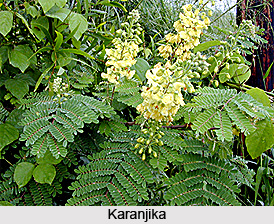
 Karanjika Pant is an Indian evergreen medicinal Plant. It is a robust, thorny, climbing shrub up to 25 metre tall. The stem of this plant is stout and woody, branchlets are downy. The stems are also covered with golden-hair which often forms dense thickets. The stem thorns are straight to hooked and are not in regular rows or confined to nodes.
The leaves are bipinnate, dark green, paler beneath, not glossy, up to 300 mm long. The leaflets up to 8 mm wide are membranous, elliptic to elliptic-oblong. Flowers are bright yellow or dark red in colour, in conspicuous axillary and terminal racemes, petals are suborbicular and bright yellow.
Fruits are linear-oblong, winged, beaked, 4-9-seeded, and the seeds are ellipsoid and dull black.
The native land of this plant is tropical and subtropical Asia but widely introduced and naturalized in Africa and the Pacific region. Karanjika is commonly found wild throughout peninsular India in open habitats and in thickets to an altitude of 1800 metre; commonly planted in hedges throughout India.
Etymology of Karanjika Pant
The botanical name of the plant is Caesalpinia decapetala. Karanjika is known as black bonduc in English, `karanj` in Hindi, `chillari` in Marathi, `godhchili` in Oriya and `karanjika` in Sanskrit. It is also commonly known as Mauritius or Mysore thorn or the cat`s claw.
Medicinal Properties and Uses of Karanjika Pant
The medicinal properties and uses of Karanjika are numerous. Some of the uses are follows:
•In Unani medicine the leaves of karanjika are considered laxative, tonic, carminative, antipyretic, emmenagogue and useful for treating biliousness.
•A decoction of the plant is used as a bath in cases of jaundice.
•The leaves and roots are used as a purgative and emmenagogue.
•The bruised leaves are applied to relieve burns in Himachal Pradesh.
•They are slightly sweet and are useful in treating biliousness.
•A decoction of the leaves is used to treat stomach disorders.
This article is a stub. You can enrich by adding more information to it. Send your Write Up to content@indianetzone.com