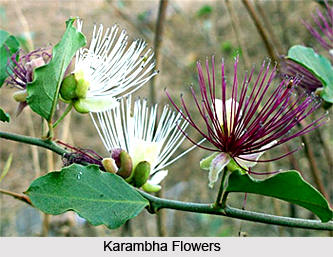
 Karambha, or Capparis zeylanica, as it is know botanically, is an Indian medicinal plant, bearing indigene local names, like: kalokera in Bengali; Ceylon caper in English; ardanda, hins, jakhambel, jhiris, karawa in Hindi; aathundi kaayi, anthundikai, govindaphala in Kannada; govindi, gowindi, wag in Marathi; govindi, lob-hyotai, osaro, oserwa in Oriya; his, hiun-garna, karvila in Punjabi; vyagranakhi in Sanskrit; adandai, adondai, atanday, tondai in Tamil; and, adonda and atonda in Tamil.
Karambha is essentially native to India and is found in most lowland localities ranging from Uttar Pradesh in the north, to the east and even south. The Indian medicinal plant also grows throughout peninsular India, commonly on hedges and bushes in dry forests and scrublands. A much-branched climbing or rambling shrub, Karambha varies between 1 to 10 metres in length, armed with 2 to 6 millimetre long, re-curved and stipular thorns. The young branches of the medicinal plant differ from brownish-red to greyish in colour, which turn tomentose, glabrous and shiny in matured years. The leaves of Karambha possess properties ranging from being sub-coriaceous, elliptic-obovate or broadly lanceolate, to having a rounded base, with its apex being mucronate. The shape of the leaves vary in size, ranging from 4 centimetres to 11 centimetres in length and 1.3 centimetres to 4.5 centimetres in breadth, with the venation prominent on both surfaces.
The petioles of Karambha measure within 0.3 centimetres to 0.8 centimetres in length. Flowers of this Indian medicinal plant grow profusely, which are in fact also showy, measuring 5.1 centimetres in diameter. The petals are pinkish-white in colour, which later turn pink or reddish-violet. The upper petals of Karambha are yellow at its base and are placed in positions varying from being solitary or 2 to 6 together. They are arranged in axillary corymbs or cymes, spread serially along branches. The edible fruit or berry is sub-globose in shape, with a smooth texture that measures within 3 centimetres to 5 centimetres in diameter on a thickened stalk. They change colour from bright scarlet to purple when mature, bearing five to seven seeds. The seeds of this Indian medicinal plant appear globular in shape, embedded in a gelatinous white pulp. Karambha flowers between February and April and fruits in June in central India.
The bitter root bark of the Indian medicinal plant Karambha is considered a good appetiser, stomachic, demulcent, sedative, anti-hidrotic and is useful for relieving fever and colic. The leaves are used in northern India as a counter-irritant. When ground into a paste, the Karambha leaves are applied as a poultice to relieve glandular swellings, piles and boils. A decoction of the leaves is given in cases of syphilis. Yet again, the leaves, ground with pepper, tamarind and garlic, are together taken by the Irulars of Tamil Nadu to amplify appetite. The root and leaf are used in Ayurveda to treat oedema, glandular swellings and filariasis. The tender Karambha fruits are eaten as a vegetable among the tribal inhabitants of northern Andhra Pradesh.