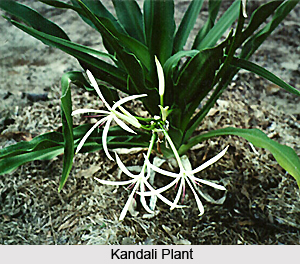
 The botanical name of kandali is Crinum defixum Ker. This herb is commonly known as `sukdarshan` in West Bengal, the people of Gujarat call the herb as `nagrikand` and ` kandali` is called in Sanskrit and is a common Indian medicinal plant.
Kandali is an erect herb with large globose or oblong bulbs and is 7.5 centimetres to 10 centimetres in diameter. The herb contains a few or many leaves. They are 60 centimetres to 90 centimetres long and 2 centimetres to 4 centimetres wide. The leaves are linear, concave or channelled, thick and the margins of the leaves are slightly rough, are apex acute or obtuse. The plant has flowers of white to reddish colour. They are borne in approximately 6 to15 flowered umbels on a 45 centimetres to 75 centimetres long, have cylindrical stalk, with 2 oblong-lanceolate bracts 3.8 centimetres to 5 centimetres long. The perianth tube is 6 centimetres to 13 centimetres long, cylindrical, segments nearly as long, narrowly linear-lanceolate, reflexed or drooping. The filaments are shorter than perianth segments, are spreading, and bright red in colour. The fruits of kandali are subglobose, 2.5 centimetres in diameter, short-stalked, beaked by the perianth tube and the seeds are rugose.
Kandali is generally found in wet habitats along with the riverbanks throughout India. The herb is found in damped areas, most commonly in West Bengal and in peninsular India up to 900metre elevation. This herb carries immense medicinal properties and so it is often cultivated in gardens.
The bulb of kandali is considered emollient and emetic, and is used in small doses as a nauseant and diaphoretic. The juice of the leaves is reportedly used as an eardrop to treat the disease of otitis. In Ayurveda, the leaf, rhizome and corm are used as a substitute for those of Crinum latifolium and are used to treat gout, oedema, leprosy and fever. The leaves of kandali are used to treat dropsy, earache, carbuncles and paronychia mainly in Siddha.