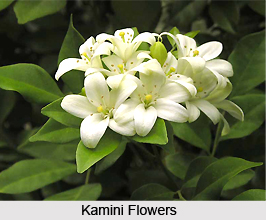
 Kamini is the common name of Murraya paniculata (L.) Jack. In English it is known as honey bush, in Kannada the name of the plant is angarakana. The names of the plant in other languages like Konkani, Marathi, Oriya, Sanskrit, Tamil and Telugu are pandhri, kunti, banmallika, ekangi, kariveppilai and ganarenu. The plant is found throughout India and the Andaman Islands. It is commonly grown in gardens for its attractive glossy green foliage and large clusters of fragrant flowers. It is a popular hedge plant, well adapted for topiary work.
The plant is handsome evergreen shrub or small tree with a spreading crown and short, often crooked, trunk; bark pale yellowish-brown to white, thin, rather corky, fragrant. The leaves are alternate, imparipinnate, 10-17 cm long; leaflets usually 3-5, mostly 3-7 cm long, ovate or elliptic-lanceolate or rhomboid, glossy and darker above, gland-dotted, base cuneate or rounded. The flowers are white, fragrant, borne in axillary, few-flowered, corymbose cymes. Fruit an oblong or ovoid berry, red or deep orange when ripe, containing 1-2 seeds.
The leaves are stimulant and astringent; they are reportedly used in the form of an infusion to treat diarrhoea and dysentery in the Philippines. The powdered leaves are applied to cuts to promote healing; their decoction is taken internally to treat dropsy. Among the Baigas of northeastern Madhya Pradesh, the crushed leaves are made into a paste and mixed with molasses to make tablets that are taken orally to treat joint pains; the leaves, cooked with mustard or sesame oil along with dried ginger, are applied externally to relieve inflamed joints. The warm leaf paste is applied externally to promote the healing of broken bones among the Paudi Bhuinya in northern Orissa. In the Gandhamardan Hills of Orissa, the leaves and twigs are boiled to make a bath that is used to relieve stomach-ache in children and rheumatic pains in adults. The leaves and root bark are sometimes used to treat rheumatism, coughs and hysteria. The root bark is reportedly taken internally and used as an external rub to relieve body-aches. The bark of both the stem and roots is used as an anti-diarrhoeal. The twigs are used for cleaning teeth. The leaves possess antibiotic activity against Micrococcus pyogenes var. aureus and Eschehchia coli.