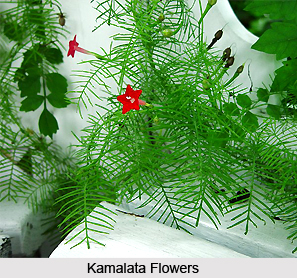
 Kamalata or Kamlata is a well known Indian medicinal plant, having the botanical name of Ipomoea quamoclit L. The plant has the English names like Indian Pink and Red Jasmine and it has a large number of names in various native Indian languages, as well. Kamlata is the Sanskrit name of the plant and it is also called as Tarulata in Sanskrit. The other name, Kamlata is the plant`s Hindi name and its other name in Hindi is Kamalata. The Bengali speaking people call the plant as Kamalata and Tarulata and the Marathi names of the plant are Sitachekesa, Vish-Nukrant and Vishnukrantu. The plant has the Tamil names like Kem-Bumalligai and Mayirmanikkam and in Telugu; it is known as Kasir-atnamu.
Kamalata is a graceful, slender, glabrous and annual vascular plant, with 1-9 cm long leaves. The leaves are ovate to elliptic in outline, and they are deeply pinnatisect with 9-19 alternate or opposite pairs of linear, glabrous lobes. The flowering part of the plant has solitary flowers or 2-6-flowered cymes and its 0.9-2 cm long flowers have pedicels. The plant`s sepals are elliptic to oblong and obtuse, having a length of 4-7 mm, while the corolla is of brilliant crimson, scarlet or rarely white colour. The corolla is 2-3 cm long. The fruits of the plant are capsular, ovoid, and their length is 6-8 mm. The conical and dark brown to black seeds of Kamalata or Kamlata, have dark patches or short, irregularly scattered trichomes. The plant usually flowers and fruits between the months of July and November in peninsular India.
Kamalata plant is being widely cultivated in gardens in India, at present. It has some useful medicinal properties and usages and is being used in various traditional Indian treatment methods. The plant is considered cooling and demulcent and its pounded leaves are applied as a poultice to relieve haemorrhoids. A mixture of the juice of this plant and ghee (butter-fat) is also taken internally. The Indian people use the leaves of the plant as a plaster in the treatment of carbuncles and the powdered root is used to induce sneezing, as well.