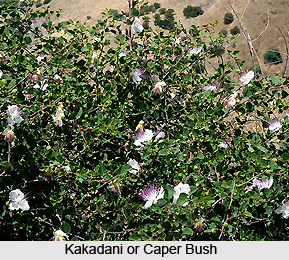
 Kakadani is essentially an Indian medicinal plant bearing Capparis spinosa as its scientific name. Kakadani however is also popular by its regional dialects, like: caper bush in English; kalo kan-tharo, kantharo in Gujarati; ber and kabra in Hindi; kathari mullina gida, katrimulli-nagidda. marattamaggu, mullukattari in Kannada; barar and kaur in Punjabi; himsra and kartotti in Sanskrit; kokilakshamu in Telugu; and, kabar in urdu.
Kakadani medicinal plant is extensively distributed in habitats that are found in dry, rocky and stony soils in north-western India, through Punjab, Rajasthan, southwards through western and southern regions of peninsular India. It is fundamentally a diffused prostrate shrub or climber armed with divaricate light yellow to orange-coloured thorns or stipules. The leaves of this Indian medicinal plant are variable in texture, measuring within 1.2 centimetres to 3 centimetres in breadth and are orbicular to elliptic in shape. The base of the leaves of Kakadani are rounded or cuneate, with the apex as mucronate. This Indian medicinal plant bears handsome flowers, which are white, axillary and solitary in placement. The fruits or berries measure within 2.5 to 5 centimetre in length, which are ellipsoid, ovoid or obovoid in shape, with a thin pericarp. The seeds of Kakadani bear a smooth texture, which is further globose and 3 to 4 millimetres in diameter.
The Indian medicinal plant Kakadani possesses various medicinal properties, which are utilised in grave treatment of diseases. The root bark is used extensively in Ayurvedic and Unani medicine, credited with aperitive, tonic, diuretic, expectorant, anthelmintic, emmenagogue and analgesic properties. The plant is used to treat rheumatism, paralysis, toothache, as well as splenic, renal and liver ailments. An extract of Kakadani plant is one of the constituents of the Ayurvedic preparation Liv-52, administered to treat preliminary cases of acute viral hepatitis and cirrhosis of the liver. Kakadani extract also has shown encouraging results against viral infections in humans. The plant extract is also a constituent of another Ayurvedic drug Geriforte, useful in the treatment of senile pruritis, itching and other ailments associated with old age and anxiety neurosis. The dried flower buds have an acrid, astringent taste and are useful for curing scurvy. The pickled flower buds constitute the commercial capers, used in cooking worldwide and in India, together with the fruits for flavouring pickles, relishes and sauces. The bruised Kakadani leaves are used as a poultice in the treatment of gout.