 Kailashahar is a nagar panchayat town in Tripura. Kailashahar is the headquarters of the Unakoti district in the Indian state of Tripura located along the Bangladesh border.
History of Kailashahar
History of Kailashahar reveals the medieval and the early history of Tripura Kings. The history of old Kailashahar is associated with Unakoti District, a tourist place reputed for its 7th - 9th century AD stone and rock cut images. A 15th generation descendant of King Jujhar Fa, a Shiva disciple who started the Tripurabda, a Tripuri Calendar, prayed for Lord Shiva or Mahadeva in a village called Chhambulnagar on the banks of the river Mau. It is speculated that Chhambulnagar, which is mentioned in Rajmala, was situated near Unakoti Hill. The Prince prayed for Mahadeva in Unakoti. For this some people believe that the previous name of Kailashahar was Chhambulnagar. Some believers thought that Lord Shiva or Mahadeva resides in Kailash. Therefore the place was known as Kailash Har which was later on transformed to Kailashahar. A Tripura king named Adi-Dharmapha ruled here in 7th century. He performed a great yajna with much pomp and gaiety. The name Kailashahar found currency since that time. Kailashahar was the ancient capital of the Tripuri kingdom.
Demography of Kailashahar
Kailasahar had a population of 20,279. Males constitute 51% of the population and females 49%. Kailasahar has an average literacy rate of 82%, higher than the national average of 59.5%: male literacy is 84%, and female literacy is 79%. In Kailasahar, 10% of the population is under 6 years of age. There is not much population in Kailashahar and many people are living in poverty but there are also some those are very rich and some that live in foreign countries. It is mainly populated by Bishnupriya Manipuris. This tinsel town is the cultural pillar of Tripura from time immemorial.
Culture of Kailashahar
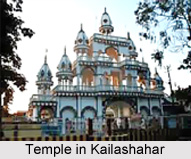
Like other North East India people of Bengali descendant, Bishnupriya Manipuris and hills lived together happily for long time. But in recent time there was violence between them. The main reason is economical deprivation of land and livelihood of the tribals and the indigenous people. The main festival in Kailashahar is the durga puja festival that occurs between September-October and is where all the kids, elderly and adults enjoy. The city of Kailashahar is also known for its bright festival of lights "Kali Puja". One of the biggest Kali Puja Pandals is hosted in this small city. Hinduism is the dominant religion and there are many temples across the city of Kailashahar. The religion Islam has also many followers and there is a mosque right next to the main bazaar. Buddhism is also followed by many people. Christianity is also a growing religion with the majority of the Christians among the native being Tripuri people. Most of the Christians are of the Baptist denomination.
Visiting Information
Kailashahar is connected to the rest of India mainly by road. The town also has an airport that is currently closed but will resume soon. The nearest rail connection is in Kumarghat.