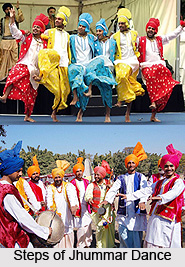
 Jhummar or Jhoomar dance is a folk dance performed in the Punjab state of India. The term Jhumar is derived from Jhum or Jhoom, which means Swaying. Jhummar is a very lively form of dance which signifies happiness. Balochi and people of Southern Punjab Pakistan mostly practice this traditional dance. This graceful dance is quite popular at the weddings and other major functions and festivals of Punjab.
Origin of Jhummar Dance
It is believed that this dance has originated from Sandalbar, now situated in Pakistan, but is very much a part of Punjab folk heritage. It is a dance based on specific Jhummar rhythm.
Performance of Jhummar Dance
Jhummar dance is performed exclusively by men; it is a common feature to see three generations - father, son and grandson - dancing all together. Therefore, in some part it is termed as generation dance. The performance of this dance takes place in a circular form. The dancers dance around a single drummer standing at the centre. It is danced to the tune of emotional songs. The dance does not include any acrobatics and only the arm movements are considered as its main forte. Toes are musically placed in front and backwards and in the same way turnings are taken to the right or left. Sometimes the dancers place their one hand below the ribs on the left and gesticulate with the right hand. This dance is not tiresome and it is normally performed on moonlit nights in the villages away from the habitation. While dancing, the dancers let-off a sound, "dee dee" in tune with the beat of the dance, which adds in its overall performance.
Costume of Jhummar Dance
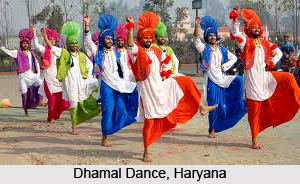
The costume of Jhummar is similar to Bhangra; colourful, graceful and matches the rhythm of dance. They wear a coloured Patka on the head, a lungi, a long tunic and a waistcoat.
Types of Jhummar Dance
There are various types of Jhummar dance like Satluj Jhoomar, Beas Jhoomar, Chenab Jhoomar, Multani Jhoomar and Jhoomar Taari. Each of the type which is named on the rivers flowing in southern Punjab has a different mood and is therefore suited to different occasions and for all reason of that predominating mood.