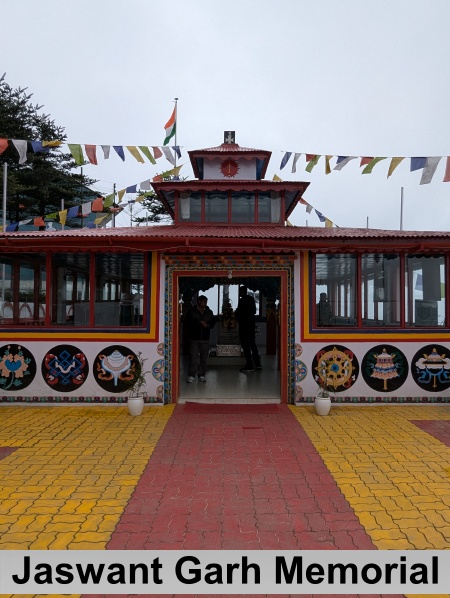
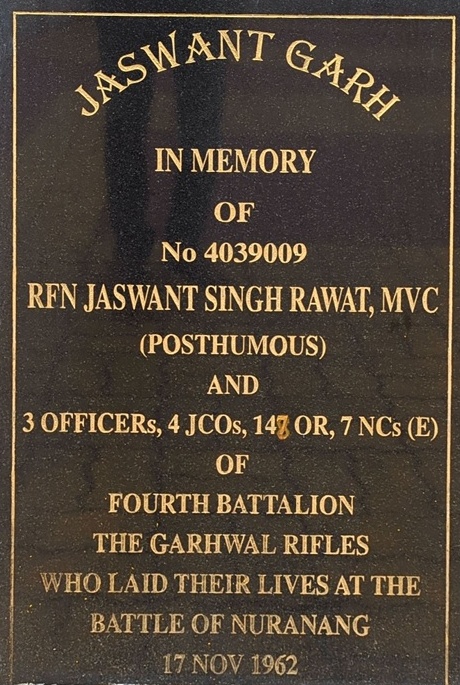
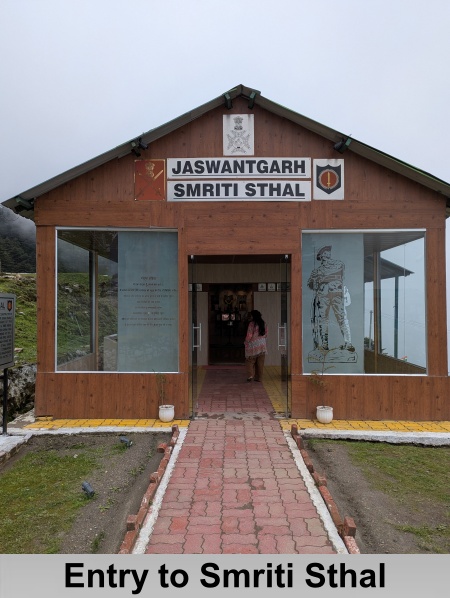
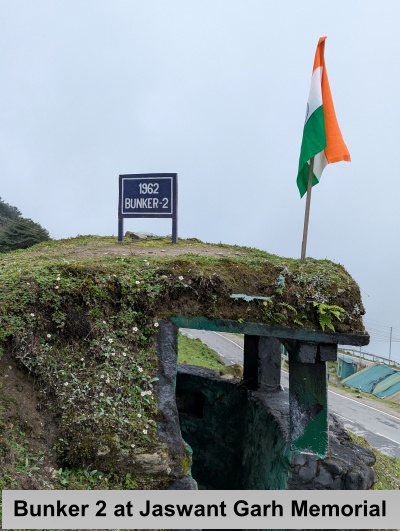
Battle of Nuranang was fought in the remote hills of
Arunachal Pradesh near Tawang. The place symbolizes the extraordinary courage and
sacrifice of the 4th Battalion of Garhwal Rifles under the able
leadership of Lt. Col. BM Bhattacharjee, MVC. His contribution is significant
in defending the Nuranang against Chinese forces.
Nuranang, erstwhile NEFA, served as a strategic point for
the Indian army. The terrain is replete with rugged mountains and narrow
passes, making it a natural fortress and also vulnerable for attack. This makes
defense of this pass crucial to prevent the entrance of Chinese forces further
in the Indian territory. Although, initially, the Indian forces were pushed
back by the Chinese forces, the soldiers of the 4th Battalion of
Garhwal Rifles exhibited extraordinary bravery wherein the Alpha company, under
the command of 2nd lieutenant SN Tandon, repulsed 6 major attacks,
inflicting as many as 300 casualties upon the enemy. The army used the
mountainous terrain to their advance to delay the advance of Chinese troops
while allowing a more organized withdrawal of Indian troops and civilians from
the area.
Rifleman Jaswant Singh Rawat achieved a feat in this
situation when he, armed with an automatic rifle, and limited ammunition,
held-off Chinese forced single-handedly, taking on overwhelming numbers.
NEFA Sector (North-East Frontier Agency): NEFA Sector
is strategically important for India due to its borders with China, Bhutan, and
Myanmar. Its proximity to the McMohan Line demands strong defensive posture. The
rugged terrain with mountains, valleys, and forests complicates military
operations, especially in high-altitude warfare where specialized training and
equipment are required. Also, the river system of the region creates natural
barriers and essential resources for effective military strategies to protect
India’s interest.
Dhola incident: This incident took place in September
1962 that showcased the bravery and resilience of Indian soldiers. During a
critical phase of the Indo-China conflict, the 4th Battalion of the
Rajput Regiment was positioned at Dhola, near Thag La Ridge as part of India’s
forward policy. Indian troops displayed remarkable courage when surrounded by
Chinese soldiers. Indian soldiers held their ground against all adversities although
they had to retreat later. This incident exemplifies the determination of
Indian army and their commitment to defend the nation.
Thag La incident: On October 1962, a crucial
engagement in the Indo-China war took place which is marked as the Thag La
incident. The 2nd Battalion of the 9th Gokha Rifles and
the 4th Battalion of the Rajput Regiment established positions on Thag
La ridge as part of India’s Forward Policy. In response, the Chinese army
launched a surprise attack with superior numbers and coordinated tactics.
Despite the valiant defense by Indian troops, they faced heavy casualties due
to logistic challenges. This incident led to a major set for India in the Sino-Indian
War.
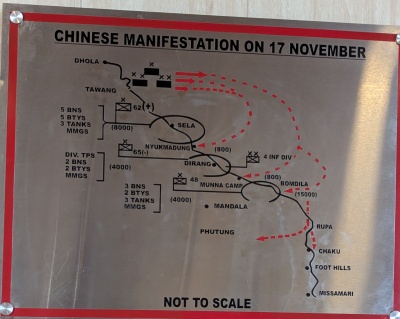
Chinese Manifestation: On November 17, 1962, around
3000 Chinese soldiers launched an attack against the 4th Battalion
of Garhwal Riles at Nuranang. Despite being heavily outnumbered and facing
natural harsh conditions, Indian soldiers held their ground with immense
courage. Indian troops displayed remarkable valor, proving their dedication to
defend the nation against all odds.
Chinese Advance to Bomdila: On November 1962, Chinese
troops captured Bomdila in Arunachal Pradesh after fierce battles in Sela and
Dirang. The Chinese army utilized two major axes, namely the Bum La-Tawang axis
and Mago-Chuna axis. Despite severe communication breakdown, Indian troops held
their ground strong until thy were forced to retreat. Their bold stand against
all odds showcased the courage of Indian forces in defending their homeland,
even with limited resources and challenging topography.
Kameng Heights Occupation: During the 1962 war,
Indian forces occupied Kameng Heights, a strategically beneficial military
position in Arunachal Pradesh. Despite facing logistic problems, the soldiers
demonstrated resilience. Chinese soldiers launched a coordinated attack but
Indian troops defended valiantly. While Indian troops had to eventually
withdraw, their determination showed the courage of Indian soldiers in
mountainous warfare. The incident also highlighted the need for modern
equipment and training in Indian army in the future.
.jpg)
Madan Sign Rawat VrC (P)
On November 14, 1962, Rfn Madan Sign Rawat, 4th
Battalion in the Garhwal Rifle, accompanied 2 Lt Vinod Kumar Goswami on a
patrol. Their duty was to observe the activities of the enemy on the North side
of Twang Chu, and particularly in the village RHO. They were also trying to
capture a Chinese prisoner. Despite fierce resistance and sustaining grave
injuries, he displayed exceptional courage in hand-to-hand combat and made the
supreme sacrifice.
Under the cover of darkness, the team infiltrated deep into
enemy-held territory. At around 23:00 hours, they stealthily approached a hut
occupied by enemy soldiers. While attempting to capture a Chinese sentry, a
brutal close-quarter firefight and hand-to-hand combat erupted between Indian
and Chinese soldiers. Rifleman Rawat fought bravely and grappled with enemy
soldiers, sustaining fatal injuries in the fierce encounter. For his
exceptional bravery and devotion to duty, he was posthumously awarded the Vir
Chakra.
.jpg)
Trilok Singh Negi VrC (P)
On November 14, 1962, near Nuranang bridge, Lance Trilok
Singh Negi was commanding a company when they were attacked in repeated waves
by Chinese soldiers. Throughout his action, Lance Naik Trilok Singh Negi
displayed high order of devotion, commendable courage and a high sense of duty.
Lance Naik Trilok Singh Negi was enrolled into 4 Garhwal Rifles of the Indian
Army. Lance Naik Trilok Singh Negi, Rifleman Jaswant Singh Rawat and Rifleman
Gopal Singh Gusain, volunteered to destroy an MMG in the enemy occupied
territory. After three unsuccessful attacks, the enemy succeeded in bringing a
Medium Machine Gun very close to the Platoon and started heavy firing. Realizing
that the position of Indian soldiers would become untenable soon if the enemy
MMG was not destroyed forthwith. Lance Naik Trilok Singh Negi, Rifleman Gopal
Singh Gosain and Rifleman Jaswant Singh Rawat went to destroy it.
They crawled forward under enemy fire and reached within 10
to 15 yards of the target. While Lance Naik Trilok Sigh Negi undertook covering
fire with his Sten gun, Rifleman Jaswant Singh Rawat and Rifleman Gopal Sigh
Gusain hurled grenades on the enemy MMG. The grenades exploded and without
losing time both of them rushed towards the MMG position. They saw two Chinese
lying dead and another, though badly wounded, still holding the MMG. They
jumped on him and overpowered him. Rifleman Jaswant Singh Rawat snatched the
MMG and both of them returned to their own position under the covering fire
provided by the Lance Naik Trilok Singh Negi. While covering the return of the
two riflemen. Lance Naik Trilok Singh Negi was badly wounded by a burst of
enemy automatic fire. He continued covering his comrades until he succumbed to
his injuries. On November 17, 1962, he was posthumously awarded the Vir Chakra
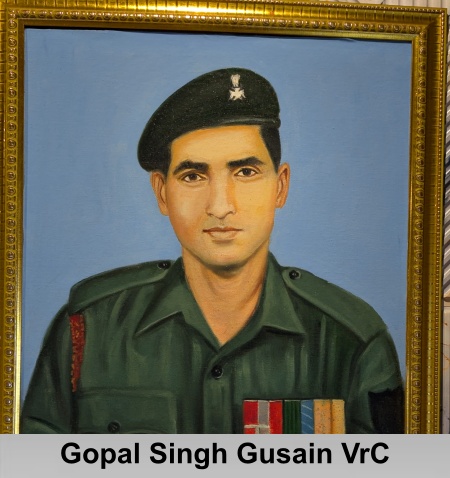
Gopal Singh Gusain VrC
Rifleman Gopal Singh Gusain, a native of Pauri Garhwal in
Uttarakhand, served with the 3 Garhwal Rifles and distinguished himself through
extraordinary bravery during the 1962 Sino-Indian War. On 17 November 1962,
during the second phase of the conflict, Chinese forces launched a fierce
attack on his company’s position near the Nuranang Bridge in Arunachal Pradesh.
At the time, Rifleman Gusain was a member of a section
commanded by Naik Trilok Singh Negi. As the battle intensified, the Chinese
brought heavy machine gun (MMG) fire upon the Indian position, threatening to
make the defense untenable. Recognizing the grave danger posed by the enemy
weapon, Lance Naik Negi, Rifleman Gusain, and another rifleman volunteered for
a daring mission to neutralize the MMG. Displaying exceptional courage, the
three soldiers advanced towards the enemy position, overpowered the Chinese gun
crew, and seized the machine gun. They then began carrying the captured weapon
back to their own lines. During their withdrawal, Lance Naik Negi provided
covering fire for his comrades but was severely wounded by a burst of enemy
automatic fire.
Despite sustaining injuries himself, Rifleman Gopal Singh
Gusain remained determined to complete the mission. He successfully brought the
captured MMG back to the trench, significantly easing the pressure on his
company and helping stabilize the precarious situation. Following the action,
the wounded rifleman was evacuated for medical treatment.
Through their fearless actions, both Naik Negi and Rifleman
Gusain demonstrated remarkable courage, devotion to duty, and selfless
commitment in keeping with the finest traditions of the Indian Army. In
recognition of his exceptional gallantry, perseverance, and bravery in the face
of the enemy, Rifleman Gopal Singh Gusain was awarded the Vir Chakra, the
nation's third-highest wartime gallantry award.