 The Indian medicinal plant, jasmine tree is an evergreen or semi-deciduous tree and grows up to 7 metre. Jasmine tree has the botanical synonym of Plumeria acuminata Ait. This plant is commonly known as `Gorur Champa` in Bengali, `Chameli` in Hindi, `Kat Champa` in Oriya, `Perungalli` in Tamil and `Svetacampaka` in Sanskrit. Jasmine tree is also considered as a plant that has medicinal properties. Though the distribution of the tree among the tropical lands indulged India to come into the list of its cultivation, this tree is reckoned to be native to the American tropics. It was later introduced and occasionally naturalized in many tropical countries.
Though Jasmine tree possesses medicinal properties, Jasmine flowers are highly accepted for their usage in decoration and other purposes. For its fragrance it is used as an ornamental and often the women use them to decorate their hairdo. The flowers are also used for perfume making. Jasmine flower is grown often near temples and is used in worshipping of God.
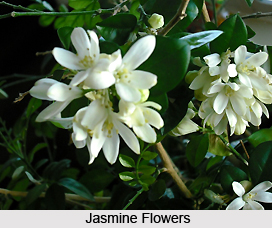
Jasmine tree has a crooked trunk and the branches are fleshy. It has swollen rough bark. The bark and branches generate ample amount of latex when cut. The leaves are un subdivided or elliptic and 15 cm to 30 cm long, generally borne at the ends of branches. The jasmine flowers carry a sweet smell. They are large, cream or white in colour with yellow at the centre, sometimes in terminal cymes pink-flushed outside. The fruits are divaricate and linear-oblong or ellipsoid. The fruits are brownish-black in colour, seeds are oblong, winged and are with pappus. Jasmine tree bears flowers almost throughout the year but fruits come out rarely in every season.
The entire Jasmine tree incorporates the properties of medicine and is used for medicinal purpose. According to Ayurvedic practice many parts of the plant are considered medicinal. Ayurveda considers that the therapeutic properties of Jasmine tree are the same as those of Michelia champaca {Magnoliaceae). A decoction of the bark of the Jasmine plant is regarded as a stimulant and is used as a purgative, emmenagogue and febrifuge. This medicinal plant is taken with coconut, ghee (i.e. clarified butter) and rice to treat diarrhoea. The medicinal value of this plant is also used to palliate dropsy and venereal diseases.
The root bark of Jasmine plant is reported to be a powerful purgative and antiherpetic and is sometimes used to treat venereal sores. In Unani practice, the medicinal herb is used to treat tumours and rheumatic pains. The latex of the plant has rubifacient and purgative properties. The latex is considered as an ingredient of external applications used to relieve itches, rheumatism and gum problems. The Jasmine flowers are considered contraceptive. The leaves of Jasmine plant are used as a febrifuge. The leaves are used in the form of a paste and applied as a poultice to relieve indolent swellings and as a rubifacient for rheumatism. Though Jasmine plant serves to be a medicinal plant, there are some precautions to be remembered as it also may bring harmful effect. The excessive doses of the latex derived from Jasmine tree are poisonous, and the root is a violent cathartic.