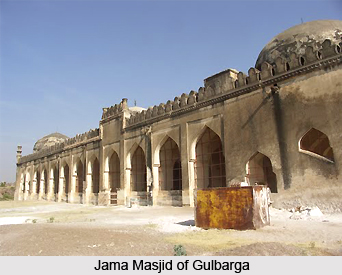
 Jama Masjid of Gulbarga is regarded as one of the most architectural mosques in its form and structure in South Asia. The arches design of Jama Masjid of Gulbarga reflects in the interiors of Spanish Mosque of Hyderabad.
These are only two mosques in India which have the similarity in interiors of the Great Cathedral-Mosque of C¢rdoba in Spain. Jama Masjid of Gulbarga was built by Muhammad Shah I to commemorate Gulbarga as the capital of the Bahmani Sultanate dynasty. The Bahmani dynasty was founded by Ala al-Din Hasan Bahman Shah, a Bahmin`s servant at the court of Muhammad bin Tughluq. The Bahmanids established themselves in Gulbarga once the Delhi Sultanate began losing its hold.
Jama Masjid of Gulbarga does not have minarets. Built inside the Gulbarga Fort is a unique mosque with a huge dome and smaller ones as embellishments. It was built in 1367 AD, by a Spanish (Moorish) architect. It has a large dome on the west side and middle-size domes at the four corners of the mosque, which looks very beautiful to see. Instead of having a courtyard, it has 63 small domes in lines in the central area. It is regarded as one of the most architecturally unique mosques in its form and structure in South Asia. The main entrance is at the north side and has a higher arch-shaped gate than the other sides. The outer walls, which usually are solid, are instead open arcades to allow in much-needed light that would generally be filtered in from a courtyard. In the west prayer room pillars are painted in white with no decoration. In addition, wide spans of these pillars` supporting large arches create a majestic atmosphere.
The floor plan measures 216 feet by 177 feet (66 by 54 meters) with wide vaulted cloisters defining the perimeter. The west bay is spacious and covered in the centre with a high dome, which is surrounded by twelve smaller domes. This high central dome is given even greater prominence by being slightly larger and because it is placed on an arcade, forming a square cloister that rises above the smaller domes.
The interior of the mosque is the span of arches, which turned out rather appealing and were used in many other Deccan buildings. The arches here have a very wide span and are support on short imposts. These unconventional `stretched` arches later became a characteristic of Deccani architecture.