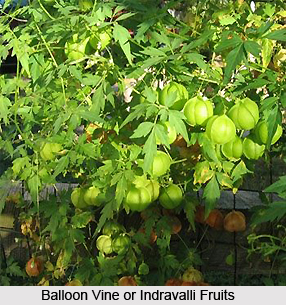
 Indravalli is a very popular Indian medicinal plant known for its huge curative properties. Scientific name of Indravalli is Cardiospermum halicacabum. There are several other names of this medicinal plant. Indravalli is a term in Sanskrit language. Other names in this language are jyotishmati, jyotismati and karavi. In Bengali language, Indravalli is also called as lataphatkari, nayaphatki and sibjhul; in English its names are balloon vine, blister creeper, heart pea, heartseed and winter cherry; in Gujarati Indravalli is known as kag-doliyo and karolio. In Hindi language it is called as kanphuti; whereas agniballe, bekkina budde gida and kakaralata are its names in Kannada. Moreover, in Malayalam it is known as jyotishmati, katabhi, paluru-van, ulinna and uzhinja; in Marathi it is called as kanphuti, kapala-phodi; and in Tamil, Indravalli is called as moedakot-tan, mudukottan, samuttiram. Indravalli is Pan Tropical in distribution and it is commonly found as a weed throughout the country up to an elevation of 1200 metres.
Indravalli is an annual or sometimes perennial climber, up to 3.5 metres tall. Leaves of this medicinal plant are alternate, deltoid, biternate, 3 to 8 cm long, petioles around 8 cm long; and its leaflets are deeply dentate or lobed, acuminate. Flowers of Indravalli are white, around 3 to 4 mm long, with a pair of peduncles modified into tendrils. Fruits (capsule shaped) of this popular medicinal plant are 3-valved, covered with bladder-like calyx, winged at the angles; seeds globose, black, smooth, nearly 4 to 6 mm in diametre, with a small, white, heart-shaped aril. In central India, it flowers between August and November and fruits between October and January.
There are several medicinal properties and uses of Indravalli. It is considered useful for promoting hair growth, and for treating rheumatism, nervous disorders, piles, chronic bronchitis, fevers, hydrocele, amenorrhoea, sprains and oedema. The roots and leaves of this medicinal plant are diuretic, laxative, stomachic, rubifacient and alterative. Among the tribal inhabitants of western Maharashtra, the whole plant is crushed in milk and applied to relieve swellings. The Rabari tribe of the Barda Hills in Gujarat uses the whole plant, crushed in groundnut oil, as an external application to relieve fever, jaundice and swellings. The juice of the plant is used to treat ear aches and to reduce hardened tumours. The herb is used in hair-oil preparations for curing dandruff, alopecia [hair loss), and for darkening hair; the aqueous extract is used as a cooling hair wash. Extracts from the plant have shown sedative effects on the central nervous system, as well as significant analgesic, anti-inflammatory, vasodepressant and antispasmodic activities.
Further, the leaves of Indravalli are emetic and stimulant and in powdered form are used externally for healing wounds. Their decoction is given in the treatment of piles, and an infusion for general sores. The pungent vapour from the crushed leaves is inhaled to relieve headache, and the juice is taken internally to reduce obesity. The fresh leaf-juice is sometimes given to asthma patients; among the rural inhabitants of Bhavnagar District in Gujarat, it is used to treat ear ache. A decoction of the leaf, with jaggery (molasses) and pepper is used to treat fever associated with cough. The leaf ash, mixed with coconut oil, is applied to relieve boils among the Kolam tribe of Andhra Pradesh. The root is mucilaginous and considered diuretic, diaphoretic, emetic, emmena-gogue, laxative and useful for treating asthma, colic, rheumatism, and the early stages of hydrocele. The juice from the pounded roots is taken orally for treatment of diarrhoea and dysentery among the Kolams of Andhra Pradesh. The aerial roots of this plant are used to induce abortion. A decoction of the roots is useful in treating amennorhoea, gonorrhoea, nervous diseases, haemorrhoids and erysipelas.