 The Indian Subcontinent provides suitable habitats to various species of birds for residing and nesting. Starlings are no exception in this regard. A number of starlings have been traced in India. They belong to the kingdom, Animalia; phylum, Chordata; class, Aves; order, Passeriformes; family Sturnidae; and genus, Phaethon. These starlings are described below.
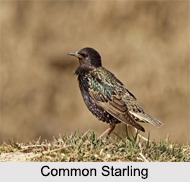
Common Starling
Common Starling is a widespread winter visitor of northern India. It is an iridescent black bird, which is glossed purple or green and glittering with white (especially in winter). The bill of the bird is narrow and conical with a sharp tip.
 The male bird has yellow bill with blue-grey base in summer, whereas the female has lemon yellow beak. In winter, Common Starling assumes brownish-black bill. It has stout legs, which are pinkish or grayish-red in color. The male bird has long and loose throat feathers. Its female counterpart has smaller and more pointed throat feathers. Common Starling is largely insectivorous and depends on both pest and other arthropods for survival.
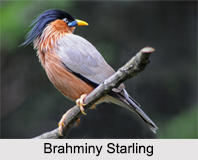
Brahminy Starling
In India, Brahminy Starlings are generally recorded in pairs or small flocks in open habitats on the plains. This Starling is a pale buff creamy bird. It has a black cap and a loose crest. The bird has a yellow colored bill, with a bluish base. It has pale iris. There is a bluish patch of skin around the eye. The primaries of the bird are black and are devoid of white patches. The adult male has a more prominent crest than the female and also has longer neck hackles. This bird is omnivorous and depends on fruits and insects for survival.
Rosy Starling
 Rosy Starling is a winter visitor of India. The adult of this species can be identified as having pink body, glossy black head, wings and tail and pale orange legs and bill. The breeding male has elongated head feathers which form a wispy crest that is fluffed and becomes more prominent when the bird gets excited. The male bird appears dull in winter. The female bird has short crest and lack the sharp separation between pink and black. This bird mainly depends on fruits, berries, flower-nectar, cereal grains and insects for survival.
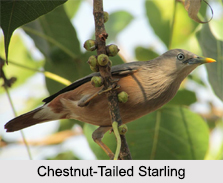
Chestnut-Tailed Starling
Chestnut-Tailed Starling is a resident or partially migratory species found in wooded habitats in India. This starling has grey upperparts and blackish remiges. The color of the rest of the plumage differs in case of subspecies. One of the subspecies of the Chestnut-Tailed Starling is S. m. malabarica. This subspecies has been recorded in north-eastern India. Chestnut-Tailed Starling depends on fruits, nectar and insects for survival.