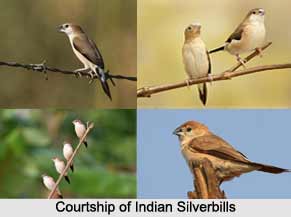
 Indian Silverbill or White-Throated Munia is an Indian bird that bears a scientific name "Lonchura malabarica" and they are closely related with African Silverbill.
Category of Indian Silverbill
Indian Silverbill is a small passerine bird found in Indian states like Gujarat, Rajasthan and Jharkhand and adjoining regions that was formerly considered to include the closely related African silverbill (Lonchura cantans).
Range of Indian Silverbill
This Estrildid Finch- Indian Silverbill is a common resident breeding bird in the drier regions of the Middle East and the Indian states. It has also been introduced into many other parts of the world and has become established in some areas. They forage in small flocks in grassland and scrub habitats.
Structure of Indian Silverbill
The adult Indian Silverbill is 11-11.5 cm long and has a conical silver-grey bill, buff-brown upperparts, white under parts, buffy flanks and dark wings. The tail is black and the wings are dark contrasting with a white rump. The sexes are similar, but immatures have buff under parts and a shorter tail. The tail appears pointed as the length of the feathers reduces from the centre outwards. It feeds mainly on seeds, but also takes insects and has been known to visit nectar bearing flowers, such as those of Erythrina trees.
Description of Indian Silverbill
Indian Silverbill was described as Loxia Malabarica by Linnaeus who placed it along with the Crossbills. Subsequently they were included in the genera Uroloncha and Aidemosyne and later in the genus Lonchura into which many of the estrildid finches were included by Jean Delacour in his 1943 revision. The species earlier included Lonchura cantans, the African Silverbill, which is found in the dry savannah habitats south of the Sahara Desert. In captivity the African birds were found to preferentially pair with mates within their own populations and did not recognize the Indian populations as con specific. They are however known to produce fertile hybrids.
Habitat of Indian Silverbill
Indian Silverbill frequents dry open scrub, fallow land and cultivation, sometimes near water. Although mainly found on the plains, they can be found up to about 1200 m in some sub-Himalayan regions.
Concentration of Indian silverbill
Indian Silverbill occurs in Pakistan, Nepal, Bangladesh, India, Sri Lanka, Iran and Israel. It has been accidentally introduced into many other parts of the world.
Behaviour of Indian silverbill
Indian Silverbill are gregarious and are found in flocks of as many as 60 birds. They feed on the ground or on low shrubs and grass stalks. They constantly utter a low cheeping or chirping contact call as they forage. They visit water and drink with a rapid sip and swallow action.
Feeding of Indian Silverbill
Indian Silverbill feeds on a wide range of grass seeds and will also make use of crop species. The breeding season is spread out and varies with region.
Nests of Indian Silverbill
Indian Silverbill nests in winter in southern India and after summer in northern India. They nest, an untidy ball of grasses with an opening on the side is placed in low shrubs, often on thorny Acacia and is known to make use of the old nests of Baya weaver sometimes even visiting those that are occupied by the weaver birds. They will sometimes build their nest below the platform nests of vultures or storks.