 The Indian Subcontinent provides suitable habitats to various species of birds for residing and nesting. Jays are no exception in this regard. Various species of jays have been recorded in India. They belong to the kingdom, Animalia; phylum, Chordata; class, Aves; order, Charadriiformes; family, Corvidae and genus, Garrulus. These are jays described below.
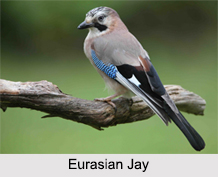
Eurasian Jay
The scientific name of Eurasian Jay is G. Glandarius. This bird has a white crown, which is streaked in black. The bird also has white-colored forehead, lores, eye"s area, chin and throat. Its eyes are bluish-white. The bird has blackish bill, which is strong and has whitish to buffy rictal bristles. It has a noticeable black malar stripe. It has pinkish-grey to reddish-brown upperparts. Similar to the upperparts are nape and head sides of the bird. Rump and uppertail coverts of the Jay are pure white and the vent and undertail coverts are also white in color. Tail color of the bird is black. Upperwing exhibits rufous lesser and median coverts and bright blue finely barred black primary and outer great coverts. The remaining upperwing exhibits black to grey-black feathers with white bases or edges, giving a complex wing pattern very noticeable in flight. The bird has pinkish-brown legs and feet. The juvenile has darker body plumage, greyer bill, more bluish eyes and brighter legs.
Black-Headed Jay
The scientific name of Black-Headed Jay is G. Lanceolatus. It is a pinkish-grey plumaged bird, but in dull light the color turns grayer. Top of the head of the Jay is black in color. There are elongated feathers on the crown of the bird, which forms a crest. Its bill is pale grey to pale horn and the eyes are dark brown. The bird has black colored chin and throat, which is heavily streaked in white. Its belly and undertail-coverts are pink in appearance. The upperwing exhibits black lesser and median coverts and contrastingly white primary coverts. The secondary flight feathers have blue and black barred pattern with wider black subterminal bar and white tip. Tertials are pale grey, also with wide subterminal black bar and white tip. Primary flight feathers are dark grey with bluish outer webs and narrow whitish edges. The long tail of the bird is blue and finely barred in black, with slightly wider subterminal black bar and white-tipped rectrices. Male and female birds are known to be similar.