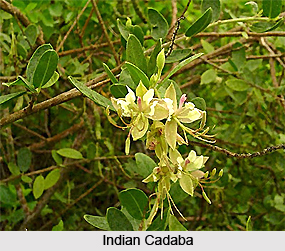
 Indian Cadaba is acknowledged by its Botanical synonym of Capparidaceae Cadaba fruticosa in the scientific society. Although, this particular Indian medicinal plant possesses other Indianised local-language names, like: kalokat-tiyo and khordu in Gujarati; chegaviche, maragache, she-gurti in Kannada; kattakatti in Malayalam; kalitaka and kalitakal in Marathi; kattagatti, vilivi, villi in Tamil; and, adamorinika, chavukutti-vaaku, chemoorda Telugu.
Indian Cadaba is commonly distributed and found throughout the drier lowland regions of India. This Indian medicinal plant is essentially an unarmed, straggling and much-branched shrub, reaching up to 3 metres in height, bearing cylindrical stems. As the plant grows older, it turns smooth and purplish, whereas, the younger variation is pubescent and yellowish-brown in colour. The leaves of Indian Cadaba vary between 1.2 centimetres to 3.5 centimetres in length and 0.8 centimetres to 1.8 centimetres in breadth. The shapes of the leaves appear to be ovate-oblong or ovate, together with additional features of being glabrous and entirely margined. The apex is framed at an angle that is acute or obtuse-mucronate, with the base being rounded and venation well-defined beneath. The petioles of Indian Cadaba measure within 0.2 centimetres to 0.4 centimetres in length. The flowers of this said Indian medicinal plant however bear an appearance of dirty-white, that are 1.5 centimetres.
The bracts of Indian Cadaba are minute and subulate from the exterior, with the sepals measuring within 8 millimetres to 13 millimetre in length, which sustain properties of being pubescent. The two outer sepals are boat-shaped, while the two inner are flat, ovate and acute. This Indian medicinal plant has four petals that are pale yellow in colour and shaped like a spatula. The petals equal themselves with the sepals, together with long claws that are slender. The fruits or capsules of Indian Cadaba are shaped between linear to oblong, which are also cylindrical, measuring between 2.5 centimetres to 4 centimetres in length. The fruits also bear secondary properties of being muricate, glabrous or pubescent, together with sharing properties of being dehiscent and irregularly torulose. The seeds are black in colour, marked with striations, together with dimensions of being reniiorm-rotundate. Indian Cadaba`s seeds are shaped like a comma, which are compressed and approximately 2 millimeters in diameter, embedded in a yellowish-orange or red aril. The plant flowers between November and March and bears fruit from January to April in central India.
Indian Cadaba, the Indian medicinal plant finds usage in various chronic ailments, known to be effective for prolonged periods. The leaves and roots are considered deob-struent, anthelmintic and emmenagogue and are prescribed in the form of a decoction for treating uterine obstructions. The leaves of Indian Cadaba are also used as a poultice to promote healing of sores. In Siddha, the leaf and fruit are used to treat worm infestation, swellings, eczema and constipation.