 The Indian Subcontinent provides suitable habitats to various species of birds for residing and nesting. Adjutants are no exception in this regard. Greater Adjutant and Lesser Adjutants are the two adjutants which have been recorded in India. They belong to the kingdom, Animalia; phylum, Chordata; class, Aves; order, Ciconiiformes; and family, Ciconiidae. These adjutants are described below.
Greater Adjutant
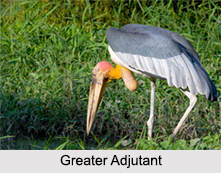
Greater Adjutant is restricted to a much smaller range with only two small breeding populations, one of which is in India. In India, the largest colony of Greater Adjutant is in Assam. This bird is the most endangered stork of the world. The bill of the bird is huge, wedge-like and pale grey with a darker base.
 This bird resembles a vulture due to its white collar ruff at the base of its bare yellow to red-skinned neck. During the breeding season, Greater Adjutant assumes bright orange pouch and neck. The upper thighs of the grey legs become reddish. The adult bird has a dark wing that contrasts with light grey secondary coverts. It is difficult to tell the male and female birds apart in the field. If the bird is duller in appearance, it can then be identified as a juvenile bird.
Lesser Adjutant
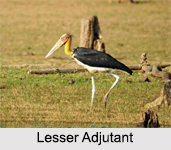
In India, Lesser Adjutants are mainly distributed in the eastern states of Assam, West Bengal and Bihar. This large bird is known for its upright stance. It has a straight upper bill edge and the skullcap is paler. It has a bare head and neck without a pendant pouch. There are a few scattered hair-like feathers on the nearly naked head and neck of the bird. The upper plumage is uniformly dark, more specifically black. The upper shank or tibia is grey rather than pink. The belly and undertail are white in color. The breeding bird can be identified in terms of reddish face and orange neck. The larger median wing coverts are tipped with copper spots and the inner secondary coverts and tertials have narrow white edging. If the bird has more feathers on the nape and looks duller than the adult, it can then be identified as a juvenile.