Hymns of Rig Veda

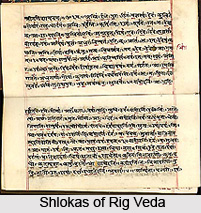
Hymns of Rig Veda or the Vedic Hymns in Rig Veda or Suktas are mainly composed in the praise of Gods to bestow the human beings with worldly pleasures.

About Hymns of Rig Veda

Hymns of Rig VedaHymns of Rig Veda are one thousand and twenty eight in number. These are also known as Suktas or Vedic Sanskrit Hymns. These Vedic Hymns of the Rig Veda written in Sanskrit are in praise of several deities and are chiefly meant to serve the purpose of the families of the priestly class who were considered to be the hymns addressed to various deities, and mostly arranged to serve the needs of the priestly families who were the guardians of the sacred text in Hinduism.

Rig Veda hymns are believed to be the oldest and most vital of all the Vedas, being penned between the period from 1500 BC and the period of the famous Bharata war which was during 900 BC. There are one thousand and twenty eight Hymns which are coordinated into 10 Mandalas or chapters or circles. The second and the seventh Mandalas are considered to be the oldest while the tenth Mandala is regarded as the most recent. Since it is the only available writing in India dating back to the ancient period, the Rig Veda is well-known as the most prominent source of knowledge, while the ethical doctrines appear to have bettered from the old hymns to the mystic Upanishad.

The Rig Veda is mainly dominated by hymns which are composed in the praise of the Aryan gods for providing them with wealth and victories from the local Dasas by warfare. The Aryans generally utilised their advancement in skill and weaponry in fighting to seize the tribal and agricultural peoples of the withering Harappan culture. Several hymns are composed which give reference to the use of horses and chariots having spokes which must surely have given the then warriors a suitable advantage. Spears, arrows, bows and iron weapons find a place in these hymns. Like a pastoral and nomadic culture praising war they founded a fresh structure in society based on the patriarchal families commanded by warriors and, finally with the aid of the Vedas themselves, by priests also. Usually, the Rig Veda hymns shower praise over the gods and request them for material benefits like health, wealth, long life, victory and protection over the Dasa peoples.
Hymns on Creation in Rig Veda

The hymns on Creation in Rig Veda refer to several theories pertaining to creation. Several of these hymns regard creation as the result of a cosmic battle, such as those mentioned in the hymns to Indra, God of Rain or as a result of the apparently unmotivated act of separating heaven and earth, an act attributed to several different gods. The hymns on Creation probe the origins of the existence and the creator. On the other hand, certain hymns speculate upon the sacrifice as the origin of the earth and the people in it or upon the origins of the sacrifice. Sacrifice is central to many concepts of creation, particularly to those explicitly linked to sacrificial gods or instruments, but it also appears as a supplement to other forms of creation such as sculpture or anthropomorphic birth.

The hymns on Creation from the Rig Veda narrates that right at the beginning of the creation there was neither existence, non-entity, no world, no sky, no death, no immortality and no day or night. The Creator breathed on His own impulse. Other than Him nothing existed upon this earth. There was darkness too but the entire universe was engulfed in it. All that existed was the formless. But what led to the formation of a `Unit` was the desire to create life force.

The unique feature about these hymns is that they question the very existence of the Creator. According to these the gods came afterwards, with the creation of this universe. In fact when this creation took place or who created it; whether it was created on its own; such questions can only be answered either by the Almighty or perhaps even He does not know.

The theory of Creation discussed in the Rig Veda is partly similar to that explained in Christianity. However its questioning the Creator`s existence or his contribution in shaping the universe puts Rig Veda apart from that of Christian theories.

Recently updated articles in Indian Puranas

Kausika, Son of Vasudeva
Kausika, Son of Vasudeva Thumbnail

Kausika, Son of Vasudeva

Kausika is a minor figure in Hindu mythology and is identified in the Vishnu Purana as the only son of Vasudeva and his wife Vaishali. He is recognize...

Tandu, Attendant of Lord Shiva
Tandu, Attendant of Lord Shiva Thumbnail

Tandu, Attendant of Lord Shiva

Tandu is revered as the divine attendant of Lord Shiva and the foremost exponent of the Tandava dance. According to the Natya Shastra, he instructed S...

Niramitra, Mahabharata
Niramitra, Mahabharata Thumbnail

Niramitra, Mahabharata

Niramitra was a son of Nakula and Kareṇumati in the Mahabharata. A descendant of the Pandavas and the Kuru dynasty, he fought on the Pandava side duri...

Mahodara, Ramayana
Mahodara, Ramayana Thumbnail

Mahodara, Ramayana

Mahodara was a prominent Rakshasa warrior, minister, and army chief who served under Rāvaṇa during the Battle of Lanka in the Ramayana. Celebrated for...

Lalabaksha, Hell in Purana
Lalabaksha, Hell in Purana Thumbnail

Lalabaksha, Hell in Purana

Lalabaksha is one of the hells described in Hindu Puranic literature, particularly in the Bhagavata Purana and the Devi Bhagavata Purana. It is a real...