 History of Munger District reveals that this territory was a part of the "Midland" of the first Aryan settlers. The derivation of the name Munger (Monghyr) has found the subject of much speculation.
Early History of Munger District
Tradition ascribes that this original was derived from the Mons (Mundas), who occupied this part before the advent of the Aryans. History of Munger District states that the present site of the town was apparently comprised within the Kingdom of Anga, with the capital Champa near Bhagalpur. Anga comprises the modern districts of Bhagalpur and Munger. In the epic period, Modagiri finds mention as a separate state. The success of the Anga did not last long and about the middle of the sixth century BC Bimbisara of Magadha is said to have killed Brahmadatta, the last independent ruler of ancient Anga. Hence Anga became an integral part of the growing empire of Magadha. Epigraphic evidence of Gupta period suggests that Munger was under the Gupta Empire.
Medieval History of Munger District
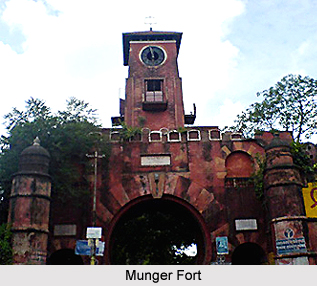
Till the advent of the Turkish rule in India, Munger was under sway of the Karnataka dynasty of Mithila. Munger came under the control of Sultan of Bengal within 1301-1322, which is corroborated by the Lakhisarai Inscription. Munger came under the possession of Muhammad Bin Tughlaq who annexed Munger to Delhi for some time. Nasrat Shah succeeded Hussain Shah in Bengal in 1590 and he took possession of Munger Fort and entrusted its responsibility to his general Kutub Khan who made Munger the head quarters of Bihar army. Later, Munger was for some time the headquarters of Akbar`s officers in their expeditions against the rebels.
Modern History of Munger District
The modern history of Munger came into prominence in 1762 when Kasim Ali Khan made it his capital instead of Murshidabad district in West Bengal. The British army moved on rapidly towards Munger District and at this time Munger was placed under the command of Arab Ali Khan.
The subsequent history of Munger District is uneventful with the extension of the British dominions, the town of Munger ceased to be an important frontier post. Munger, however, was still important for its fine situation and salubrious air and was used as a sanatorium for the British troops. But during the early part of the 19th century Munger was degraded to a lunatic asylum for soldiers where there was also a depot for army clothing and it became an invalid station for British soldiers. Munger District was formed as a separate district in 1832.