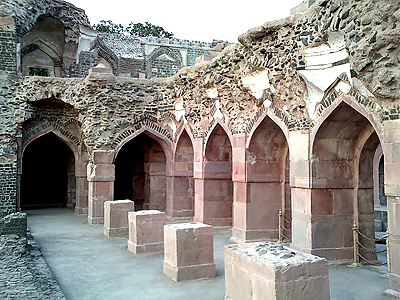
 The history of Mandu is defined by various conflicts and invasions as various rulers conquered it from time to time. Mandu or Mandavgad is a ruined town in the district of Dhar in Malwa region, Madhya Pradesh. During the 11th century, Mandu was the sub division of the Tarangagadh kingdom. Mandu was originally known as Shadiabad, which meant, The City of Happiness or Anandnagari. The name was bestowed by Ala-ud-din Khilji. Mandu was initially founded as a fortress retreat by Raja Bhoj in the 10th century. In 1304, Muslim rulers of Delhi eventually conquered Mandu. In 1401, Mughals conqured Delhi, the Afghan Dilawar Khan, governor of Malwa, set up his kingdom here. Hoshang Shah, his son, moved the capital to Mandu from Dhar and this marked the beginning of the golden age of Mandu. He was succeeded by his son Mohammed, last ruler of Ghuri dynasty.
Mohammed Khalji poisoned Mohammed Shah and established the Khilji dynasty. In 1469, Ghiyas-ud-din, his son, succeeded Mohammed. He spent most of his life in seeking pleasure and built the Jahaz Mahal as a harem. In his final years, Ghiyas-ud-din was poisoned by his own son, Nasir-ud-din. Bahadur Shah of Gujarat invaded and conquered Mandu in 1531 and Mahmud II, the 6th Khalji ruler, surrendered without putting up any resistance. Bahadur Shah in turn was defeated by Humayun and by 1534, Mandu came under his control. But he eventually lost to Mallu Khan, an officer of the Khalji dynasty, and Mandu came under his rule. After a decade of invasions and warfare, Baz Bahadur appeared at prime position.
Sher Shah Suri had defeated Humayun by now. After the death of Sher Shah Suri in 1545, his son Islam Shah succeeded him, but he also died in 1553. Feroz Khan, his 12 year old son, became the next ruler, but was murdered within 3 days by Adil Shah Suri. During Adil Shah`s rule, several revolts and uprisings took place as he was mostly an inept ruler. Hemu, Adil Shah Suri`s Chief of Army and Prime Minister, attacked and conquered Mandu by defeating Baz Bahadur. Hemu became the Governor of Mandu. In the second Battle of Panipat, Hemu was defeated and killed by Akbar, and Mandu was included in the Mughal Empire. In 1732, the Marathas, led by Peshwa Baji Rao I took control of Mandu.
After the capital of Malwa was moved back to Dhar, during the Maratha rule, the decline of Mandu had begun. Eventually Mandu was abandoned and hidden by dense vegetation of the surrounding forest.