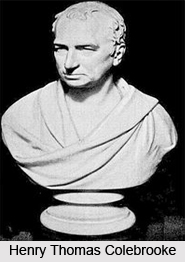
 Henry Thomas Colebrooke was an English orientalist and mathematician. He has been described as "the first great Sanskrit scholar in Europe in colonial era.
Early Life of Henry Thomas Colebrooke
Henry Thomas Colebrooke was born on June 15th 1765. Henry Thomas Colebrooke was the third son of Sir George Colebrooke. He bore the title as 2nd Baronet, Chairman of the British East India Company, and Mary Gaynor of Antigua. He was born in London. He was educated at home; and when only fifteen (15 years) he had made considerable attainments in classics and mathematics. From the age of twelve to sixteen he resided in France.
Career of Henry Thomas Colebrooke
In 1782, Henry Thomas Colebrooke was appointed to a writer ship in India. About a year after his arrival there he was placed in the board of accounts in Kolkata; and three years later he was removed to a situation in the revenue department at Tirhut now Trihut District of Bihar. In 1789 he was removed to Purneah now in Bihar, where he investigated the resources of that part of the country, and published his remarks on the Husbandry and Commerce of Bengal, privately printed in 1795, in which he advocated free trade between Great Britain and India.
Later Career of Henry Thomas Colebrooke
Henry Thomas Colebrooke was sent to Nagpur in 1799 on a special mission, and on his return was made a judge of the new court of appeal, over which he afterwards presided. In 1805, Lord Wellesley appointed him honorary professor of Hindu law and Sanskrit at the college of Fort William. He became a member of council in 1807 and returned to England seven years later. He was a director of the Royal Asiatic Society, and many of the papers in the society`s Transactions were communicated by him. In 1822 he was elected the second president of the Royal Astronomical Society.
Sanskrit Scholarship of Henry Thomas Colebrooke
After eleven years` residence in India, Henry Thomas Colebrooke began the study of the Sanskrit language; and to him was entrusted the translation of the major Digest of Hindu Laws, a monumental study of Hindu law which had been left unfinished by Sir William Jones. He translated the two treatises, the Mitacshara of Vijnaneshwara and the Dayabhaga of Jimutavahana, under the title Law of Inheritance. During his residence at Kolkata he wrote his Sanskrit Grammar (1805), some papers on the religious ceremonies of the Hindus, and his Essay on the Vedas (1805), for a long time the standard work in English on the subject.
Death of Henry Thomas Colebrooke
Henry Thomas Colebrooke died on March 10, 1837.
Related Articles
Capital Cities of India
Kolkata
History of Kolkata
Modern History of Kolkata