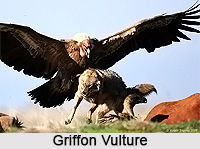
 Griffon Vulture is an Indian bird of vulture with the scientific name "Gyps fulvus" and is a large Old World vulture in the bird of prey family Accipitridae. It is also known as the Eurasian griffon.
Structure of Griffon Vulture
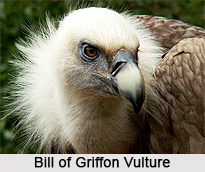
Griffon Vulture has the structure of 93-122 cm (37-48 in) long with a 2.3-2.8 m (7.5-9.2 ft) wingspan. In the nominate race the males weigh 6.2 to 10.5 kg (14 to 23 lb) and females typically weigh 6.5 to 11.3 kg, while in the Indian subspecies (G. f. flavescent), the vultures average 7.1 kilogram. Extreme adult weights have been reported from 4.5 to 15 kg, the latter likely attained a weight in captivity. Hatched naked, it is a typical Old World vulture in appearance, with a very white head, very broad wings and short tail feathers. It has a white neck ruff and yellow bill. The buff body and wing coverts contrast with the dark flight feathers.
Griffon vulture as the Scavanger Bird
Griffon vulture is a scavenger, feeding mostly from carcasses of dead animals which it finds by soaring over open areas, often moving in flocks. It establishes nesting colonies in cliffs that are undisturbed by humans while coverage of open areas and availability of dead animals within dozens of kilometres of these cliffs is high. It grunts and hisses at roosts or when feeding on carrion.
Lifespan of Griffon Vulture
The maximum recorded lifespan of griffon vulture is 41.4 years for an individual in captivity.
 Breeding of Griffon Vulture
Griffon Vulture breeds on crags in mountains in southern Europe, North Africa, and Asia, laying one egg. Griffon vultures may form loose colonies. The population is mostly resident. Juveniles and immature individuals may migrate far or embark on long-distance movements.
Feedings of Griffon Vulture
Griffon vultures evidently show no difference in feeding rates. Inevitably, as resource availability increases, feeding rates tend to follow the same pattern. Upon studying the reintroduction of this species and its impact on the intra-specific competition, old adults are more inclined to display aggressive behaviour and signs of dominance in comparison to the other age ranges. In terms of comparing the male and female sexes, there are no observed differences in competitive behaviours. Lastly, the reintroduced individuals of the species and the wild-bred do not differ in dominance or feeding rate despite the differences in upbringing.