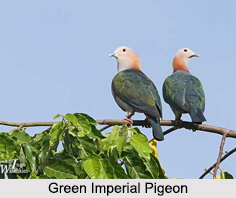
 Green Imperial Pigeon, an Indian bird that bears a scientific name "Ducula aenea", is a large forest pigeon. The adult male of nominate race has iridescent green upperparts tinged bluish or bronzy. The primary and outer secondary flight feathers and the rectrices are grey with slight greenish gloss. The head and neck, upper mantle, breast and belly are pale pinkish-grey. The under tail-coverts are dark chestnut. The grey head has some white feathers around the eyes and at bill base.
This forest bird is a widespread resident breeding bird in southern Asia, India. It builds a stick nest in a tree and lays a single white egg. It has a fast and direct flight with the regular beats and an occasional sharp flap of the wings, which characterizes the pigeons in general. This species of bird prefers the areas of evergreen forests, wooded habitats and primary and secondary forests up to 1000 meters. They are also found in mangrove areas and in open countries with scattered trees. Green Imperial Pigeons are always seen in flocks. In the early morning, they are often found on the top of the emergent tree in dense forests and at the time of resting they always perch on the highest branch of any tall tree in small groups or pairs.
Structure of Green Imperial Pigeon
Green Imperial Pigeon is a large, plump pigeon, which is generally 40-47 cm in length. Its back, wings and tail are metallic green. The head and under parts are white, apart from maroon under tail coverts. Sexes are similar. The bird`s call is deep and resonant, and is often the first indication of the presence of this treetop species. The bill of Green Imperial Pigeon is bluish-grey. The eyes are deep red. Legs and feet are reddish. Both sexes are similar with the female slightly duller than male.
Concentration of Green Imperial Pigeon
Green Imperial Pigeon is a forest species which is a widespread resident breeding bird in tropical southern Asia from India east to Indonesia. It has several subspecies, including the distinctive Celebes form, chestnut-nape Imperial Pigeon (Ducula aenea paulina) etc.
Behaviour of Green Imperial Pigeon
Green Imperial Pigeon is an arboreal dove, feeding on plant material in the tree canopy. Its flight is fast and direct, with the regular beats and an occasional sharp flick of the wings which are characteristic of pigeons in general.
Nesting and Breeding of Green Imperial Pigeon
Green Imperial Pigeon builds a stick nest in a tree and lays a single white egg. The birds are not very gregarious. Their nesting and breeding season is from December to June. The nest is built by both of the sexes. The female birds lay single or sometimes two eggs, the incubation period of which is between 15 to 19 days. Both of the sexes share the parental duties.