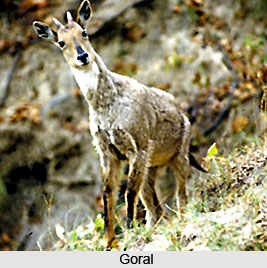
 Goral is a group of goat-like animal with close affinity to the true antelopes, which has been placed in one sub-order, Rupicaprinae. This animal is inhabits mountain areas often at lower elevation and in areas of higher rainfall, but always in terrain characterized by rugged cliffs and steep precipitous slopes. The Takin and Serow of South-east Asia, the Chamois of Europe and the Rocky Mountain Goat of North America, all belong to the same group.
Two subspecies of Goral (Nemorhaedus Goral) occur within the Indian Subcontinent. The Grey Goral is found in Kashmir and Himachal Pradesh. The Brown Goral occurs in Nepal, Assam and Sikkim. Gorals have small conical backward-curving horns (ten to twelve centimetres in length only) of almost equal length in both sexes. They have large deer-like ears and a naked moist nose-pad, but their short legs and powerful hind-quarters are more characteristic of the true goats. Grey Goral have brindled greyish fur with a conspicuous white throat-patch and a white patch on the lower jaw. The Brown Goral has a rufous brown coat and a black spinal stripe and an indistinct black stripe up the hind portion of the thigh. Adults stand about sixty six centimetres at the shoulder and weigh up to thirty kilograms.
Goral often live in regions close to human settlements because they favour lower elevations and areas with some vegetative cover. They survive because of these secretive habits, their ability to lie concealed in some crevice between boulders and to confine their feeding periods to the hours of darkness. Where not disturbed however they have been observed grazing during the day and if by chance a person actually stumbles upon their daytime retreat, they will bound away in zigzag leaps, soon disappearing behind some bushes or rocks. When disturbed or sighting danger they emit a loud staccato sort of sneeze and continue to repeat the warning call long after they have retreated to inaccessible safety.
Females reach sexual maturity at two years of age and produce one young, rarely twins, after a gestation period of two hundred and forty days. In the north-western Himalayas the young are born from mid-April to the early May. They are not very gregarious and usually graze singly but the young accompany their mother until the next offspring is born, at which time she drives them away.