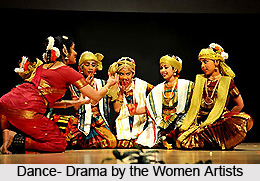
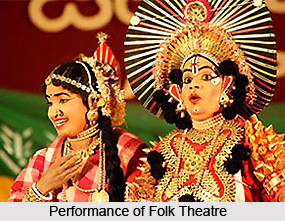
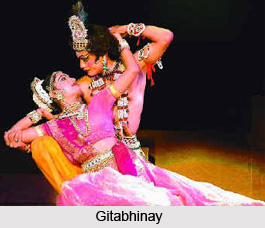
 Gitabhinay is a dance-drama form which is basically the hybrid of the indigenous Jatra (Jatra is a form of folk drama from West Bengal) and Western opera in nineteenth-century Calcutta. The literal meaning of gitabhinay can be described as lyrical acting. Gitabhinay is growing out of the new Jatra patronized by the nouveau riche.
This genre with songs almost replacing dialogue became greatly influenced by popular theatre. Devoid of Jatra`s religious overtones, it was more lyrical than dramatic, closer to the musical form. It had scene-shifts like those in a play, but no act divisions or use of flat or drop scenes. It was certainly much less expensive than a theatre production, yet free from the gross or low taste germane to the then popular Jatra.
Harimohan Ray`s Janaki-bilap i.e. `Janaki`s Laments` in 1867 may be said to have set the fashion, though Kalidas Sanyal`s Nala-Damayanti gitabhinay i.e. `Gitabhinay of Nala and Damayanti` in 1868, is perhaps the earliest specimen bearing gitabhinay in its title. Rajkrishna Ray in Patibrata natyagiti, i.e. `Opera of the Husband-server` in 1875 and Manomohan Basu in Partha-parajay, i.e. `Partha`s Defeat` in 1878 were the two main contributors to this genre.
The Tagore family`s efforts, including those of Swarnakumari Devi in Basanta-utsab, i.e. `Spring Festival` in 1879, Jyotirindranath in Manamayi in 1880, and of course Rabindranath in Balmiki-pratibha, i.e. `Valmiki`s Genius` in 1881 enriched Gitabhinay and brought it to fruition. Because of its economy in costs and popularity due to musical extravaganza, Gitabhinay enjoyed immense appeal over a considerable period in Bengali theatre even overwhelming Jatra. Some plays already popular on the proscenium stage were turned into Gitabhinay, such as Ramabhishek i.e. `Rama`s Coronation` in 1868, Harishchandra in 1874, and Sati natak i.e. `Sati`s Play` in 1874. All of them were done by Basu, Ramnarayan Tarkaratna`s Ratnabali, and Michael Madhusudan Dutt`s Sharmistha and Padmabati.
Girish Ghosh`s adoption of Sharmishtha for production by the Baghbazar Amateur Jatra Party in 1867 was in a way responsible for crystallizing the group that ushered in the professional National Theatre. The performance of Padmabati at Rajendra Mitra`s residence, attended by aristocrats like Jatindramohan Tagore, Kaliprasanna Sinha, and Satyacharan Ghoshal, reveals that this form won the approval of the Bengali elite. The rise of prosaic realism in the theatre dealt a deathblow to this short-lived yet brilliant genre.