 Garden Warbler is an Indian bird that bears a scientific name "Sylvia borin" and has the breeding habitat in European countries and migrated to India during winter times.
Structure of Garden Warbler
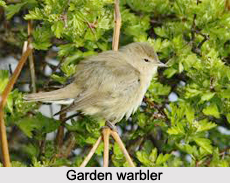
Garden Warbler is a plain, long-winged and long-tailed typical warbler with brown upperparts and dull white under parts; the sexes are similar and juveniles resemble the adults. Its two subspecies differ only slightly and interbreed where their ranges overlap. Due to its lack of distinguishing features, this species can be confused with a number of other unstreaked warblers. The garden warbler`s rich melodic song is similar to that of the blackcap, its closest relative, which competes with it for territory when nesting in the same woodland.
Breeding Habitat of Garden Warbler
The preferred breeding habitat of Garden Warbler is in Eurasia in open woodland with dense low cover for nesting; despite its name, gardens are rarely occupied by this small passerine bird.
Eggs of Garden Warbler
The clutch of four or five blotched cream or white eggs is laid in a robust cup-shaped nest built near the ground and concealed by dense vegetation. The eggs are incubated for 11-12 days. The chicks are altricial, hatching naked and with closed eyes, and are fed by both parents. They fledge about 10 days after hatching. Only about a quarter of young birds survive their first year.
Migration of Garden Warbler
Garden Warbler is strongly migratory in nature wintering in sub-Saharan Africa and India. A wide range of habitats are used in Africa, but closed forest and treeless Sahel are both shunned.
Feeding of Garden Warbler
The insects are the main food in the breeding season, although fruit predominates when birds are fattening prior to migration, figs being a particular favourite where available. These warblers have a mixed diet of insects and fruit in their African wintering grounds.
Prey of Garden Warbler
Garden Warbler is hunted by Eurasian sparrow hawks and domestic cats, and its eggs and nestlings are taken by a variety of mammalian and avian predators. It may be host to various fleas, mites and internal parasites, and it is a host of the common cuckoo, a brood parasite.
Size of Garden Warbler
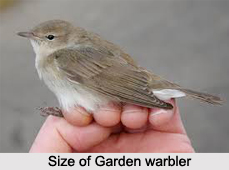
Garden Warbler is 14 cm (5.5 in) long with a 7.6-8.4 cm (3.0-3.3 in) wing length. The weight is typically 16-22 g (0.6-0.8 oz), but can be up to 35.5 g (1.25 oz) for birds preparing to migrate. It is a plain, long-winged and long-tailed bird with unstreaked olive-brown upperparts and dull white underparts. It has a whitish eye-ring and a faint pale supercilium, and there is a buff wash to the throat and flanks. The eye is black, the legs are bluish-grey and the strong bill has a grey upper and paler grey lower mandible. The male and female are indistinguishable by external appearance including size. Juveniles have a looser plumage than an adult, with paler and greyer upperparts and a buff tone to the underparts.
Climate Adaptability of Garden Warbler
Garden Warbler breeds in most of Europe between the 12-28 degree Celsius isotherms and east across temperate Asia to the Yenisei River in Siberia. Its range extends further north than any other Sylvia warbler. All populations are migratory, wintering in sub-Saharan Africa as far south as South Africa. Birds from central Europe initially migrate to the southwest, reorientation to the south or southeast once in Africa, although Scandinavian migrants may head south through the Alps and across the Mediterranean Sea. S. B. woodwardi reaches Africa by a more easterly route, many birds passing through the Arabian Peninsula. When garden warblers cross the Sahara, they fly at night, resting motionless and without feeding in suitable shade during the day.