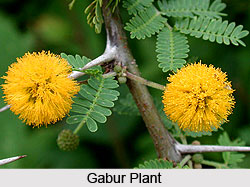
 Gabur or Ghand babul is a thorny bush or small tree with slender, zigzag branches are marked with grey or pale brown dots. Flowers of gabur are bright yellow to orange in colour and have good fragrance; fruits are sub-cylindrical in shape, slightly curved, conspicuously veined, dehiscent and dull brown in colour. This plant bears flowers from November to March, and fruits from February to June in central India. The botanical name of this plant is "Acacia Farnesiana (L.) Wild". Gabur thrives well in dry localities and on loamy or sandy soils where it may serve as a sand binder. They grow on loose sandy soil of river beds, on pure sand in plains of Punjab and require a dry tropical climate.
Characteristic Features of Gabur
Aroma is a much branched, spiny shrub or small tree, reaching a height of 2 to 4 meters. Branches are more or less zigzagging with sharp spines, 1 to 4 centimeters long; branchlet spines are smaller. Leaves are bipinnate, 5 to 8 centimeters long. Pinnae are usually 10 to 12. Leaflets are linear-oblong, 15 to 40, and 4 to 7 millimeters long. Heads are axillary, solitary or fascicled, rounded and about 1 centimeter in diameter. Flowers are numerous, yellow and fragrant. Pods are smooth, brown, nearly cylindrical, 5 to 7 cm long, 1 1.5 cm wide, straight and curved. Seeds in two series, embedded in dry spongy tissue.
Different Names of Gabur
"Gabur" or "Ghand Babul" is also commonly known as "Gaya Babul" in Bengali, "Cassie Flower" or "Fragrant Acacia" in English, "Gong-Ghoguanria" in Oriya and "Gabur" in Sanskrit. Gabur is apparently native to the northern Mediterranean coast, introduced and naturalized throughout the tropics. In India it occurs, often gregariously, in loose, sandy soils of riverbeds throughout the country; often cultivated in gardens.
Medicinal Uses of Gabur
Gabur or Ghand babul is used in Ayurveda for treating diseases. In Ayurvedic practice, the bark and heart-wood are used as substitutes for those of "Acacia catechu", in the treatment of leprosy, pruritis, wounds, bronchial asthma, distaste and stomatitis. The tender leaves, bruised in a little water, are prescribed for gonorrhoea. A bathe in the bark decoction works as a treatment for typhoid. The gummy roots have been chewed as a treatment for sore throat. A decoction of the gum from the trunk has been used in the treatment of diarrhoea. An infusion of the flowers has been used as a stomachic. It is also used in the treatment of dyspepsia and neuroses. The flowers are added to ointment, which is rubbed on the forehead to treat headaches. The powdered dried leaves have been applied externally as a treatment for wounds. An infusion of the pod has been used in the treatment of sore throats, diarrhoea, leucorrhoea and conjunctivitis.