 Many folk arts are popular in the Kanyakumari district of Tamil Nadu state of India. They play an important role in essaying the culture of their rich tradition. Some of the popular folk art forms of the district comprise of Kalial, Kathakali, Bow Song, Karagam Dance, and Kalari. They are exhibited during the time of festivals in temples and also different celebrations in schools etc.
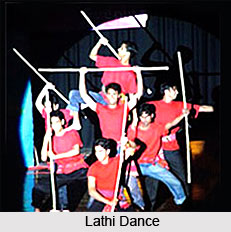
Kalial: This is a folk dance played by group of men or boys in the countryside. A group leader sings songs and keeps time with cymbals. The players stand in a circle with sticks in their hand and dance round a lighted lamp repeating the songs sung by the leader. In course of time they turn, twist, lean forward and backward, squat and move round singing to the tune. At the beginning the steps are elaborate and at times, they are also very quick. When invited to perform in a function, the players generally begin the dance with an invocation for heavenly aid and conclude the dance with a torch-dance using lighted torches. This folk dance exhibits the artistic and recreative life of the countryside a swell. This dance is very refreshing to perform as well as to enjoy.
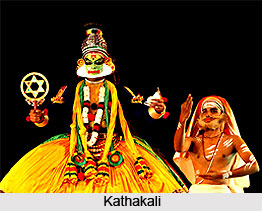
Kathakali: This is a unique form of drama, which has its origin in Travancore. Kathakali or story-dance is relatively a recent development of earlier dances. This happened during fifteenth or sixteenth century. This dance form arose out of religious expression through symbolical action. In this art form, the characters express their ideas not by words, but by significant gestures like eye movement, lip movement, etc. The movements are adopted from the Bharatha Natya with suitable modifications. The Bhagavathar recites the conversations between the characters as well as the narrative portion of the story in a loud voice. This is always accompanied by musical instrument. All these conversations should invariably be in verse. The action is promoted by his words.
The costume and make up of the actor are also important aspects in Kathakali. There are standard make up for the different types of actors. Mainly red, yellow, green, black and white are the colours used in this art form. The headdresses are made of lightweight wood and are decorated with pieces of mirror, spangles, and coloured stones. Usually, a Kathakali performance extends from eight to ten hours. With the advent of the cinema, the popularity of this art has declined. It is now played in the temples at Thiruvattar, Thirparappu, Ponmana, Kuzhithurai, Neyyoor and Munchira in the Kanyakumari district twice a year during the time of festivals. But this art form is popular worldwide and people from different parts usually come to see the presentation.
 Bow Song: This is locally known as Villu Pattu. It is an ancient form of musical - story - telling art of southern Tamil Nadu. This art is famous particularly in Southern Tamil Nadu.
Bow or the age-old weapon of warriors paradoxically lends itself to be used as a primary musical instrument for the Villu Pattu artists. Some of the important instruments that are used in these performances can be mentioned as Udukku, Kudam, Thala-Kattai etc. Udukku is mentioned in the ancient Tamil literature and it is described as Thudi, which is a small drum with a slender middle portion that is held in the left hand and played by the fingers of the right hand.
This may be seen in the pictures and statues of Lord Nataraja also. Sometimes the Villu Pattu team divides itself into two groups, each trying to prove opposite view points of a subject by conducting the programme by exchange of questions and answers. This is called Lavani Pattu. The songs used by the Villu-Pattu artists are mostly traditional folk songs. This art is transformed by generation after generation. In the present days, folk art is regarded as most ethnic one and this is perfectly transmitted by bow song.
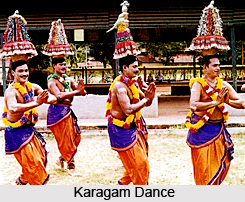
Karagam Dance: This is a kind of dance common in the countryside. Both men and women play it during the time of festivals and marriages. This is very popular and people perform it with full of joy and energy.
Kalari: This is also known as Adimurai in Kanniyakumari district. This is an ancient martial art, which is still preserved in the villages of this district and also in Kerala. A tradition believed to have been founded by Paraurama is known Vadakkan Kalari.