Sri Jagannatha Perumal Temple
This Temple of Tirumazhisai is one of the significant Jagannatha Temples of South India.

Share this Article:

About Sri Jagannatha Perumal Temple

Sri Jagannatha Perumal Temple, Tirumazhisai, Chennai, Tamil NaduSri Jagannatha Perumal Temple of Tirumazhisai is one of the significant Jagannatha Temples of South India. Tirumazhisai is a small and ancient village near Poondamallee in Tiruvallur district, which is about twenty-five kilometers north-west of Chennai. The place is considered sacrosanct to the Srivaishnavas for two reasons. It is venerated as the birthplace (Avatara-Sthala) of Tirumazhisai Azhvar, who is also popular as Bhaktisara. He authored the Nanmukan-Tiruvandadi and Tirucchanda Viruttam. It is also considered as an Abhimanasthalam. This is so because it is the home to the Jagannatha Perumal temple visited by numerous devotees everyday.

The temple of Sri Jagannatha at Tirumazhisai is the traditional and the antique temple. Hence a rich historical background is associated with the temple. According to the literary works of Srivaishnava it is evident that Tirumazhisai was originally called as Mazhisai and the prefix Tiru was added later. Hence the name Tirumazhisai indicates that it is a sacred place. It is also known as Mahisaram and Mahisarakshetram. The inscriptions found at Tirumazhisai reveal that this area was originally an agraharam or chaturvedimangalam. The consecrated place is inhabited by many learned Vedic scholars. It was also known as Agaram Cherakulavalli-chaturvedimangalam, Pakkaturaivalla-chaturvedi-mangalam and Panchanadivana-chaturvedimangalam during the Chola and Vijayanagara periods. Tirumazhisai was situated in the ancient territorial division of Mangadu-Nadu, a sub-division of Puliyur-kottam in Jayamkondachola-mandalam. The epigraphic evidences and historical texts also mention that in the ancient past, Jagannatha Perumal was called Tirumazhisai Emberuman and the temple was known as Tirumazhisai Vinnagaram. Later the temple came to be known as Jagannatha Perumal Temple.

The antique and the historical temple of Sri Jagannatha Perumal have many legendary stories associated with it. According to the legend connected with the temple, the story of the seven sages (sapta-rishis) including Brighu and Bharghava among others worshipped Vishnu at Tirumazhisai is closely associated with it. These sages request to Lord to appear and in answer to their request He appeared to them as Lord Jagannatha at this place. The deity at Tirumazhisai is popular as Madhya Jagannatha as this shrine is situated in the middle (Madhya) between Puri (Orissa) and Tirupullani (Ramnad District, Tamil Nadu). In this place there are several well known temples dedicated to Lord Jagannatha.
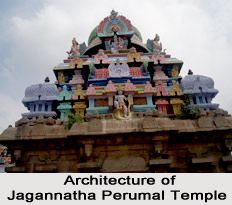

Architecture of Sri Jagannatha Perumal Temple

Architecture of Sri Jagannatha Perumal Temple, Tirumazhisai, Chennai, Tamil NaduThe architecture of Sri Jagannatha Perumal Temple lends an additional grandeur to the Temple. The unique architectural and sculptural designs are evident of the antiquity and legendary greatness of the Temple. The beautiful image of Jagannatha Perumal, the presiding deity of this temple enshrined in the main sanctum (garbha-griha) of this temple is in a seated posture reveal the artistic craftsmanship of the architect. The idol of Sri Jagannatha faces east with His left leg bent and right leg placed in front. He is flanked by His two consorts, Rukmini and Satyabhama. In front of the Lord are the images of sages Bhrigu and Markandeya worshipping the deity. The utsava-murti is the specimen of the exquisite architectural piece and is made in a posture of standing four-armed Vishnu with Sri Devi and Bhu Devi beside Him.
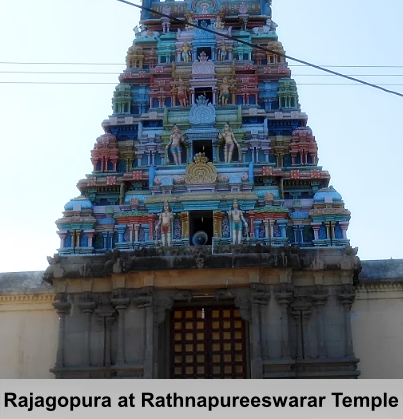
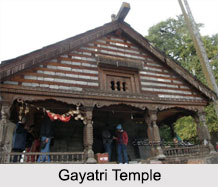
The structural design of the temple is no less beautiful. The design determines the excellence of the traditional architects. There is a Small mukha-mandapa in front of this shrine which leads to the pillared maha-mandapa in front. The Maha mandapa is a spacious structure and it is consisted of twenty-eight pillars. These pillars have the wonderful carvings depicting scenes from Vaishnava mythology. These carvings are probably of Vijayanagara workmanship, as the historical researches suggest. Opposite to this sanctum there is a tiny shrine for Garuda facing the deity. This Garuda is considered sacred by the devotees. The idols studded with beautiful carvings exemplify the superb and masterful artistry. The Vimana above this sanctum is studded with beautiful sculptures of deities like Hayagriva, Lakshmi Narasimha and Garuda, while the niches on the outer walls of this sanctum also contain well-wrought icons. There are numerous ancient inscriptions etched on these outer walls. The inscriptions became the epigraphic evidences and the data collected from those indicates that this sanctum was in existence in the Chola period even before the 12th century A.D. On the northern side of the maha-mandapa there is the sanctum for Tirumazhisai Azhvar, one of the ancient preceptors, yet considered sacred. The main image (moolavar) is seen in a seated posture with folded hands offering anjali and is facing south. The processional image is similar to the main one. There is a small mukha mandapa in front of this shrine also.

In the south-western part of the second enclosure or circumambulatory passage or prakara is seen. This is the sanctum for the Lord`s consort Tirumangaivalli Thayar and the architecture of this structure reveals that like the principal sanctum, this sanctum was also constructed during the Chola period.

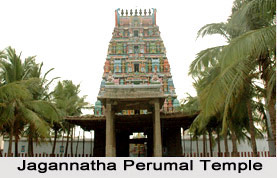
Apart from the mukha mandapa and Maha mandapa there are many other small shrines in this temple-complex for Lakshmi-Narasimha, Andal and Manavala Mamuni. The Vahana-mandapa, Kalyana- mandapa and Paramapada vasal can also be seen here. Devotees enter this temple through the eastern doorway, which has a massive gopura or the main entrance of five tiers. This gopura is profusely decorated with sculptures and crowned with seven kalashas.

The shrine itself and the idols housed in it are the exemplar of excellent architectural craftsmanship nonetheless. But the other places should be taken into consideration to determine the structural excellence. The bali-pitha and dvajastambha are the most important places, which are located very near the gopura. Outside the temple compound, situated a few yards in front of the gopura, is a small mandapa supported by four slender pillars. The mandapa supported with the pillars is an edifice of the Vijayanagara age. Tahe architectural carvings in the base-relief on these pillars depict the numerous incarnations of Vishnu, including the Matsya and Kurma avataras which is the rare feature of the sculpture. This temple also has a sacred tank known as Brighu pushkarini adjacent to it.

Thus the architecture and sculpture lend the temple an additional beauty , with enough popularity among the Jagannath Temples in South India.


Inscriptions of Sri Jagannatha Perumal temple

The inscriptions engraved on the Temple walls are the evidence of the legendry greatness of Sri Jagannatha Perumal temple. The inscription not only provides information of the chronological significance of the temple and the historical stories associated with it. Moreover the inscriptions also exemplify the socio-cultural life of the people of the contemporary period. Also the inscriptions provide information about the creator and benefactors of the temple. The Pilgrims to this temple will notice a number of inscriptions etched neatly on the walls of the shrines in the temple-complex. These historical epigraphs composed in Tamil and inscribed in the ancient Tamil script belong to the Chola and Vijayanagara times. They evidently speak of the gift of land, houses and lamps, which are made to the shrine of Jagannatha Perumal. The most ancient of these inscriptions belongs to the 12th century A.D. and is dated in the 16th regnal year of Kulottunga Chola III who ruled from 1178 to 1216A.D. This inscription records the reference of the gift of land to the shrine of Tirumazhisai Azhvar.

Apart from the above-mentioned inscriptions, many epigraphs of a chieftain named Vijaya Gandagopala who used to rule in 1250 A.D. are also seen in this temple. This ruler has mentioned himself as "Lord of Kanchi" in his inscriptions. He made numerous benefactions to various temples and the Tirumazhisai temple was no exception to this practice. The gifts to the Tirumazhisai temple were made through Gandagopala`s subordinates in charge of this area. There is also one epigraph of the courageous chieftain, Kopperunjinga who became very powerful in the 13th century A.D. in the Tamil country. Hence the inscription depicts the comprehensive list of the benefactors and their valuable contribution.

In the later part of the 13Ih century A.D., Tamil Nadu came under the control of the mighty Vijayanagara empire. The inscriptions as well as the structural design of the Jagannatha Perumal temple in that period clearly point to the influence of the Vijaynagra tradition. The earliest Vijayanagara records in this temple are those of Harihara II (1377-1404 A.D.) and approximately four inscriptions datable to his reign are found here. There are also some epigraphs of Virupaksha II (1465-1472 A.D.) which are etched on the walls of this temple.

In Tirumazhisai, near the Jagannatha Perumal temple is another shrine. This shrine is for the Lord Vishnu dedicated to Veetrirunda Perumal. Although architecturally not very ancient, there is a myth associated with this temple as the inscriptions described. In this shrine the image is believed to be a svayambhu (self-manifested). The image in the garbha-griha is similar to the one of Jagannatha Perumal.

Thus the inscription stamped on the walls of the temples providing details enhanced the legendary greatness of Sri Jagannatha Perumal Temple.


Festivals Of Sri Jagannatha Perumal Temple

The festivals observed in a temple reveal the cultural antiquity and traditional heritage of that temple. Sri Jagannatha Perumal Temple is not an exception. A number of festivals are celebrated in this temple, which are evident of the cultural heritage of the temple. In Sri Jagannatha Perumal Temple a number cultural activities are performed during the Brahmotsavam, which is considered as the famous festival here. The festival of Brahmotsavam is observed in the Jagannatha Perumal in the Tamil month of Ani (June-July). During this time is also observed the birthday of Tirumazhisai Azhvar (Tiru Avatara Utsavam). Hence the festival of Brahmotsavam and at the same time the birthday of Tirumazhisai Azhvar calls for the observation of cultural activities. The festival for this Azhvar is conducted with great pomp here as this place is his sacrosanct avatara-Sthala. Another important festival celebrated here is the float-festival (teppotsavam), which is held in the month of Masi (February-March) and continue for three long days. Adi Puram, Navaratri and Pavitrosavam are some of the important festivals, which are also celebrated in this temple. The pujas performed in the Jagannatha Perumal temple are according to the Vaikhanasa mode of worship.


Share this Article:

Related Articles

More Articles in Temples of India


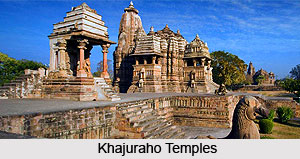
Khajuraho Temples
Khajuraho Temples are known the world over for their beauty and architectural construction. This group of temples is situated in the central Indian state of Madhya Pradesh.
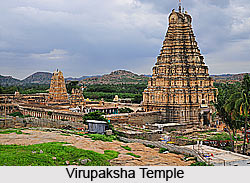
Temples In Hampi
Temples in Hampi are the manifestations of rich religious beliefs and architectural and sculptural abundance.
Dilwara Temples
Dilwara Temples located at Mount Abu date back from the 11th to 13th century and rank among the popular tourist destinations of Rajasthan.
Chola Temples
Chola Temples of South India comprises of the three great temples that were constructed in the 11th and 12th century and is declared as a World Heritage Site.
Badami Cave Temples
The Badami Cave Temples, an exemplary production of Indian architecture, are situated in the town of Badami.
Temples in Guwahati
Known to be the temple town of Assam, the temples in Guwahati are a reflection of the Assamese style of culture and architecture.
West India Temples
West India Temples are worth a visit for their beautifully designed masterpieces on stone.
North Indian Temples
India has a rich cultural and historical heritage because of its temples and pilgrimage sites. The North Indian Temples are in plenty and cater to people of all religion.
South Indian Temples
South Indian Temples lavishly built and aesthetically designed, in true sense are the symbol of architectural brilliance.
East India Temples
East India temples are really fascinating and enthralling and visit to these places can mesmerize a person very easily.
Northeastern Temples of India
Religious fervor and spiritual passion enlaces the northeastern temples of India.
Central India Temples
Central Indian temples amidst their religious fervour reverberates the true spirit of Hinduism.
Temple Architecture During Rajput Period
Temple architecture during the Rajput period was inclined to the aspect of Bhakti. Rajput kings encouraged this art which is reflected in the grandeur style of the temples.
Architecture of Mata Vaishnodevi Temple
Architecture at Vaishnodevi has been the source of artistic enjoyment for many, reinstating the vitality of the Indian religiosity and cultural fervour.
History of Sri Sanjeevi Rayar Temple
Steeped in glorious history this is indeed a legendary temple.
Temples in Munnar
Munnar houses myriad temples that are visited by many devotes throughout the year. The temples of Munnar are especially known for their festivals that are celebrated with great grandeur.
History of Indian Temples
The history of Indian temples dates back to the ancient ages and variant dynasties that have ruled throughout the ages. Every temple of every region has a story attached to it that reflects the cultures of the specific dynasty.
Kalyaneshwari Temple
Kalyaneshwari Temple is one of the well known Shakti peeth of India. Located at a distance of 20 kms from Asansol this age old temple is known for its miracles and a number of legends that attract the devotees and tourists as well.
Kalika Temple in Udhampur
Also known as Maha Kali Temple, the Kalika Temple located at the Reasi town is a holy shrine.
Medieval Temples of India
Medieval temples of India vary from each other due to the style and architecture. The impact of the prevalent kingdom is prominent in the style of building.
Temples of Ramanathapuram District
Temples of Ramanathapuram district have special significance in the state, owing to its architectural attributes.
Architecture of Brihadeeswarar Temple
Architecture of Brihadeeswarar Temple in Thanjavur reflects the Dravidian style architecture. Lord Shiva is the primary deity of this temple.